Tax Software


The total global public debt exceeds a massive USD 100 trillion, while the overall outstanding unpaid tax debts come down to billions annually. Most tax preparers start with seasonal filing services. Over time, clients begin asking bigger questions.
They receive IRS notices. They face wage garnishments. They need installment agreements. Some are dealing with years of unresolved tax debt. Suddenly, a tax practice that once handled returns now finds itself managing complex IRS cases year-round.
That transition creates opportunity but also operational pressure. A standard spreadsheet, email inbox, or basic practice management system may work during filing season, but tax resolution services demand something much more structured.
There should be better workflows, centralized communication, document tracking, compliance management, and more. This is where a CRM for tax preparers becomes so important.
The right tax resolution software helps firms strategically organize client information, automate repetitive tasks, manage IRS case workflows, and deliver a smoother client experience without overwhelming staff.
Platforms like IRSLogics are designed specifically for firms handling tax resolution work, helping tax professionals manage everything from lead intake to final resolution inside one connected platform. Let’s learn more about this.
Tax preparation alone is becoming increasingly competitive. Many firms are looking for ways to create stable, year-round revenue instead of relying only on filing season.
Tax resolution services naturally complement tax preparation because clients already trust their preparer when IRS problems arise.
Services may include:
The challenge is that tax resolution work is far more process-heavy than standard return preparation.
Each case may involve:
Without the right infrastructure, firms quickly become overwhelmed.
That is why more firms are investing in a dedicated CRM for tax preparers that supports resolution workflows instead of relying on disconnected systems.
[Visual 1]: Common Tax Resolution Blockages
Many tax firms underestimate how different resolution work is compared to seasonal filing.
A few common operational issues include:
Client records often live across emails, spreadsheets, PDFs, and multiple software platforms. This creates delays, duplicate work, and communication gaps.
Resolution cases involve constant updates and deadlines. Missing one document request or IRS notice can negatively impact the client experience.
As firms grow, multiple staff members may touch the same case. Without centralized visibility, work becomes inconsistent.
Resolution services frequently involve payment plans, milestone billing, and ongoing retainers. Manual billing processes slow firms down.
Every case should follow a structured process. Firms without automated workflows often rely too heavily on memory and manual tracking.
A tax preparer CRM helps eliminate these bottlenecks by centralizing operations inside one platform.
A CRM for tax preparers is a client relationship and workflow management platform specifically designed for tax professionals.
Unlike generic CRMs built for sales teams, tax-focused platforms support the actual operational needs of tax firms.
A modern tax preparer CRM typically includes:
The goal is simple. Instead of juggling multiple disconnected systems, firms manage their entire client lifecycle from one platform.
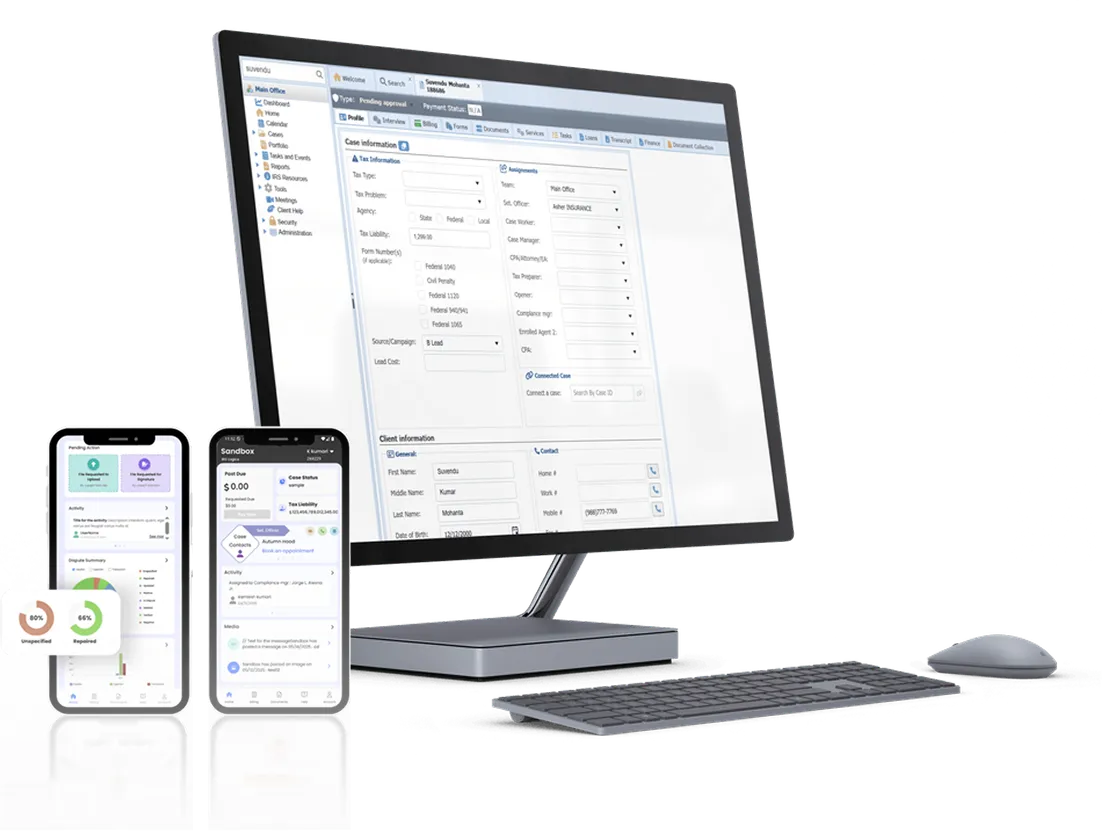
According to IRSLogics’ Tax Resolution Software, modern tax resolution platforms now support everything from lead assignment and document collection to automated billing and federal form generation. This type of centralized workflow is becoming increasingly important for firms handling growing case volumes.
Some firms initially attempt to use generic platforms like Salesforce or basic CRM tools. While these systems may work for lead tracking, they often struggle with tax resolution workflows.
Generic CRMs are not built for:
This creates heavy customization requirements and ongoing maintenance costs.
A dedicated tax preparer CRM is designed around how tax professionals actually work.
Purpose-built platforms help firms:
That operational efficiency becomes critical as firms scale their tax resolution services.
Not every platform offers the same capabilities. Firms should evaluate software based on operational needs, scalability, and workflow support.
Resolution cases involve ongoing activity over long periods of time. Strong case management helps firms track progress, deadlines, tasks, and documentation in one place.
Automation reduces repetitive administrative work. Tasks, reminders, follow-ups, and document requests should move automatically through predefined workflows.
Clients dealing with IRS issues often feel stressed and overwhelmed. Clear communication improves trust and retention.
A strong CRM for tax preparers should support:
Resolution firms frequently use payment plans or milestone billing. Integrated invoicing simplifies collections and improves cash flow.
Auto-generated IRS forms save time and reduce manual errors. This becomes especially important when handling high case volumes.
Leadership teams need visibility into:
Reporting helps firms make smarter operational decisions.
[Visual 2]: Life Before And After CRM Adoption
Clients expect transparency and faster communication. A centralized system improves responsiveness and organization.
Automation reduces repetitive work, allowing staff members to focus on higher-value tasks.
Managers and partners gain real-time oversight into every active case.
Integrated billing systems help firms improve collections and maintain consistent cash flow.
As resolution departments grow, standardized workflows make it easier to onboard staff and manage increasing workloads.
Centralized workflows reduce missed deadlines, duplicate work, and lost documentation.
A dedicated tax preparer CRM creates the operational foundation firms need to grow sustainably.
Before selecting software, firms should evaluate both current and future operational needs.
Key considerations include:
Firms handling tax resolution work require more than a simple contact database. They need operational infrastructure designed around real IRS workflows.
Managing tax resolution cases requires much more than basic client tracking. Firms deal with sensitive IRS communications, large amounts of documentation, payment coordination, deadlines, and ongoing client updates throughout the resolution process.
IRSLogics is designed to support those day-to-day operational needs through a connected platform built specifically for tax professionals.
The platform helps firms manage the complete lifecycle of a tax resolution case, starting from lead intake and client onboarding all the way to workflow management, billing, reporting, and final resolution tracking.
Some of the core services and capabilities offered by IRSLogics include:
Instead of using multiple disconnected tools, IRSLogics gives tax professionals a centralized platform built specifically for tax resolution operations. For firms adding resolution services to their existing tax preparation business, this type of structure can improve efficiency, organization, and scalability significantly.
A CRM for tax preparers is a specialized platform that helps tax professionals manage clients, workflows, documents, communication, billing, and tax resolution cases from one system.
Tax resolution cases involve ongoing communication, IRS documentation, workflows, and compliance tracking that generic CRMs are not built to manage.
Yes. Better communication, faster updates, secure document sharing, and organized workflows create a stronger client experience and improve long-term retention.
Automation reduces manual tasks such as reminders, follow-ups, task assignments, and billing workflows, helping teams work better.
Important features include case management, workflow automation, IRS forms, billing tools, reporting dashboards, client portals, and document management.
Yes. IRSLogics is built specifically for tax resolution professionals, attorneys, CPAs, and enrolled agents managing IRS case workflows.
Absolutely. Even smaller firms benefit from improved organization, automation, and visibility as they expand into resolution services.
Beyond seasonal filing work, things can get slightly challenging to continue during the tax season. Disconnected tools can hinder overall scalability significantly.
A dedicated CRM for tax preparers like IRSLogics can help to manage modern tax resolution workflows right from intake to the final resolution under one unified system. This helps firms grow year-round revenue with improved operational efficiency and higher competitive advantage.
All
Tax Software
Workflow & Automation
Industry News
Resolution Tips
Tax Resolution Marketing
Lorem ipsum dolor sit amet, consectetur adipiscing elit. Suspendisse varius enim in eros elementum tristique. Duis cursus, mi quis viverra ornare, eros dolor interdum nulla, ut commodo diam libero vitae erat. Aenean faucibus nibh et justo cursus id rutrum lorem imperdiet. Nunc ut sem vitae risus tristique posuere.


Share this article directly by email. Simply enter the recipient’s details below.

Article has been send to you.