Tax Software


A tax resolution CRM with client financing lets you track how each client pays for their case, right next to their intake, documents, and billing.
It matters because plenty of clients with IRS debt want help but cannot pay a big retainer upfront.
So the case stalls.
Not because the client said no. Because nobody could see a way to say yes.
Simple version first.
It is a CRM built for IRS case work that also records how the client is funding the engagement. Loan or financing details sit on the case itself, not in an email thread or a separate sheet.
That is different from a general sales CRM. A general CRM knows "lead" and "deal." A tax resolution CRM knows "transcripts," "Form 433-A," and "OIC."
If you are still weighing that gap, this breakdown of tax resolution CRM vs general CRM is a good starting point.
Add financing to the mix and you get one record that answers three questions:
→ Where is the case?
→ How is the client paying?
→ What is still unpaid?
Picture this. A client calls after an IRS notice. They are scared. They qualify. Your team is ready.
Then comes the fee conversation.
The client needs time. The sales rep says "let me check on options." Someone emails a financing provider. Someone else forgets to follow up.
Three weeks later, the client has gone quiet. Or hired someone faster.
Honestly, this is one of the most avoidable losses in a resolution firm.
The work was never the problem. The handoff was.
And when financing details live in five places, nobody owns the handoff.
Tax resolution client financing is not a new case type. It is a payment option attached to the case you already run.
The tool you use should treat it that way.
At this stage, your team needs the full picture fast.
The Financial Questionnaire collects income, expenses, and assets. Once the client fills it in, your firm approves it and the data flows into the IRS financial forms.
That same picture helps your sales team have a clear fee conversation, not a guess.
You can read how that works in this guide on turning a questionnaire into pre-filled IRS forms.
Now the case is live.
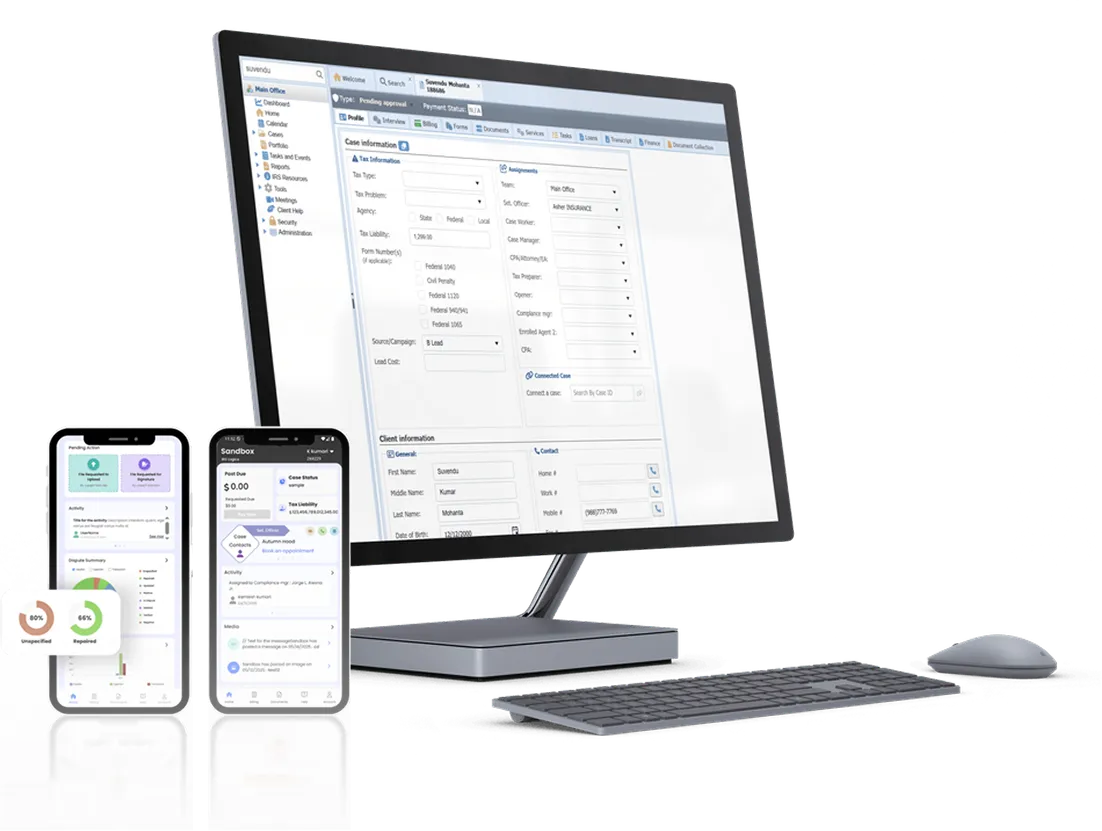
Finance tracking records the client's financing, such as a third-party provider like We Get Financing, and links it to that case.
Services tracking shows what the client contracted for.
So when a case manager opens the file, they see the scope and the payment arrangement together. No Slack message needed.
This is where most firms lose the thread.
Payments need to match invoices. Financing disbursements need to match the case. Otherwise, "paid" means three different things to three different people.
Billing and invoicing, plus a merchant account connected to the case, let your team process and record payments in one place.
A good tax resolution CRM with client financing does more than store a loan amount.
Here is a quick checklist.
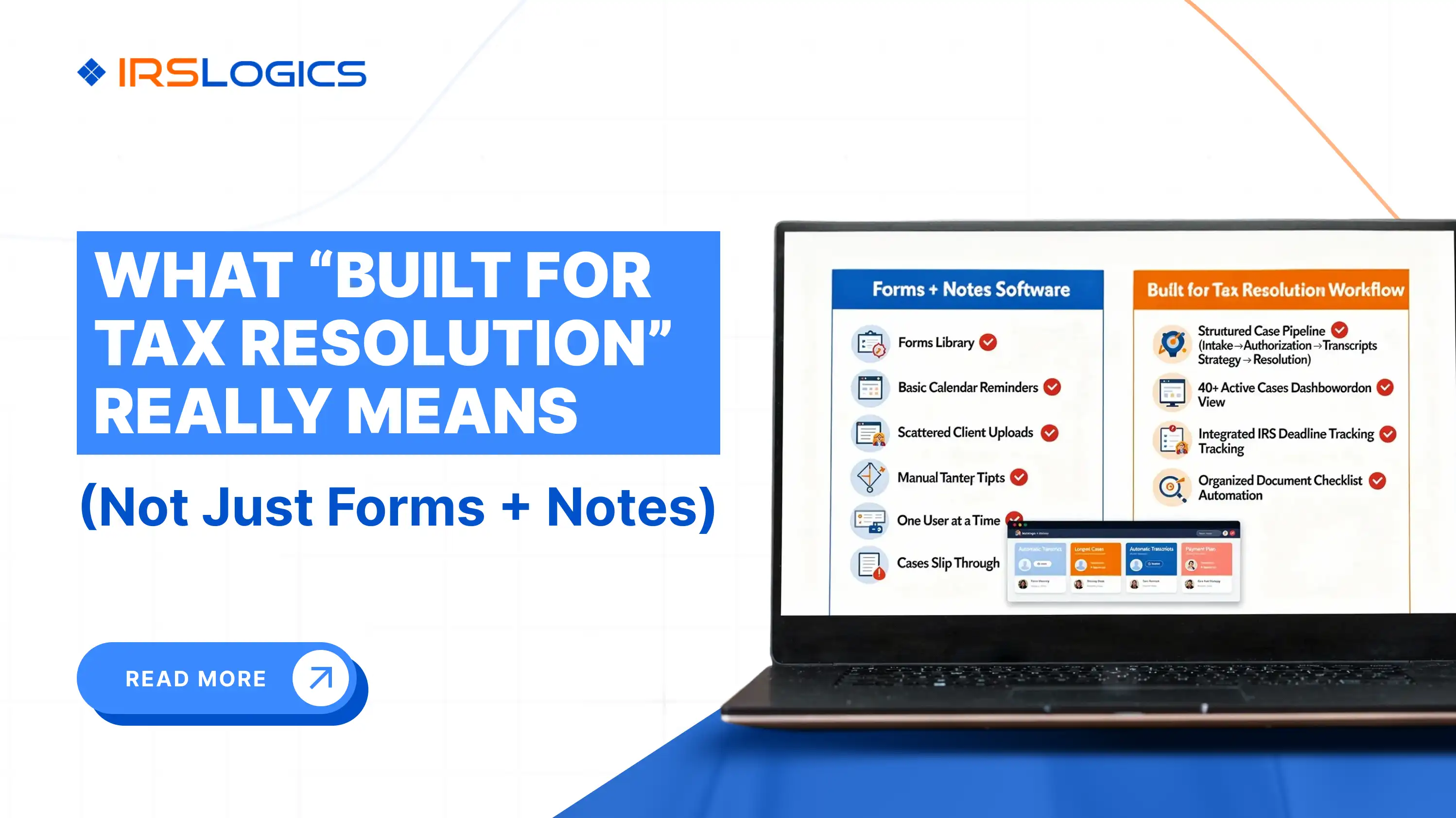
If a tool cannot show three or more of these on one screen, your team will end up building the rest in spreadsheets.
And spreadsheets do not send reminders.
Because it removes the biggest "no" in the room.
Here is the pattern.
A client who cannot pay a large retainer upfront does not always walk away. They stall. They shop around. They wait.
When your team can present a structured payment path, the conversation changes from "can you afford this?" to "here is how this works."
That helps in three ways:
→ Sales conversations stay focused on the IRS problem, not the fee shock
→ Follow-ups are tracked, so warm leads do not go cold
→ Managers see which leads are stuck at the payment step
Financing will not close every case.
But it gives more of them a fair shot.
Pair it with clear, tracked communication and you protect that momentum. A threaded SMS Conversation View keeps every client text on the case, so the next person always knows what was said.
Cash flow in resolution firms is rarely a revenue problem. It is a timing problem.
Work gets done. Payment lags. Invoices sit.
A tax resolution CRM with client financing tightens that gap.
→ Financing tied to the case means fewer delays at the start
→ Payments tied to invoices mean you know what is outstanding
→ Accounts Receivable gives your team a collections view, not a guess
That last one matters more than most firms admit.
If nobody can say which invoices are unpaid without exporting a report, follow-ups happen late, or not at all.
For a practical look at the cost side of software decisions, see this guide on tax resolution software pricing.
A few common ones.
If financing lives outside the case record, your team will forget it. Then someone calls the client about a payment that is already handled.
Awkward.
A case can be progressing while payments lag. Or payments can be current while the case is stuck.
Your system should show both, separately.
Financing the engagement does not change what the IRS requires from the taxpayer.
An Offer in Compromise still needs returns filed and payments current. Installment agreements have their own terms.
Your CRM should support the work, not hide those requirements.
Rushed financial intake leads to rework on the Form 433-A.
Start with a clean checklist before you quote a fee.
Do not judge by feature lists. Judge by one real case.
Ask for a demo that follows a client from first call to final payment.
Questions worth asking:
If you are comparing options broadly, this roundup of the best CRM for tax professionals and this overview of tax CRM software will help you narrow the field.
IRS Logics is built only for tax resolution. So financing is not bolted on. It sits inside the same case record as intake, forms, and billing.
Here is how it plays out on a normal day:
→ A case manager sends the Financial Questionnaire, and approved answers flow into the IRS forms
→ Finance tracking logs the client's financing against the case
→ Billing teams use payments tied to invoices to see exactly what is unpaid
→ The SMS Conversation View keeps payment conversations on the case
→ The Document Collection Tab tracks what the client still owes you
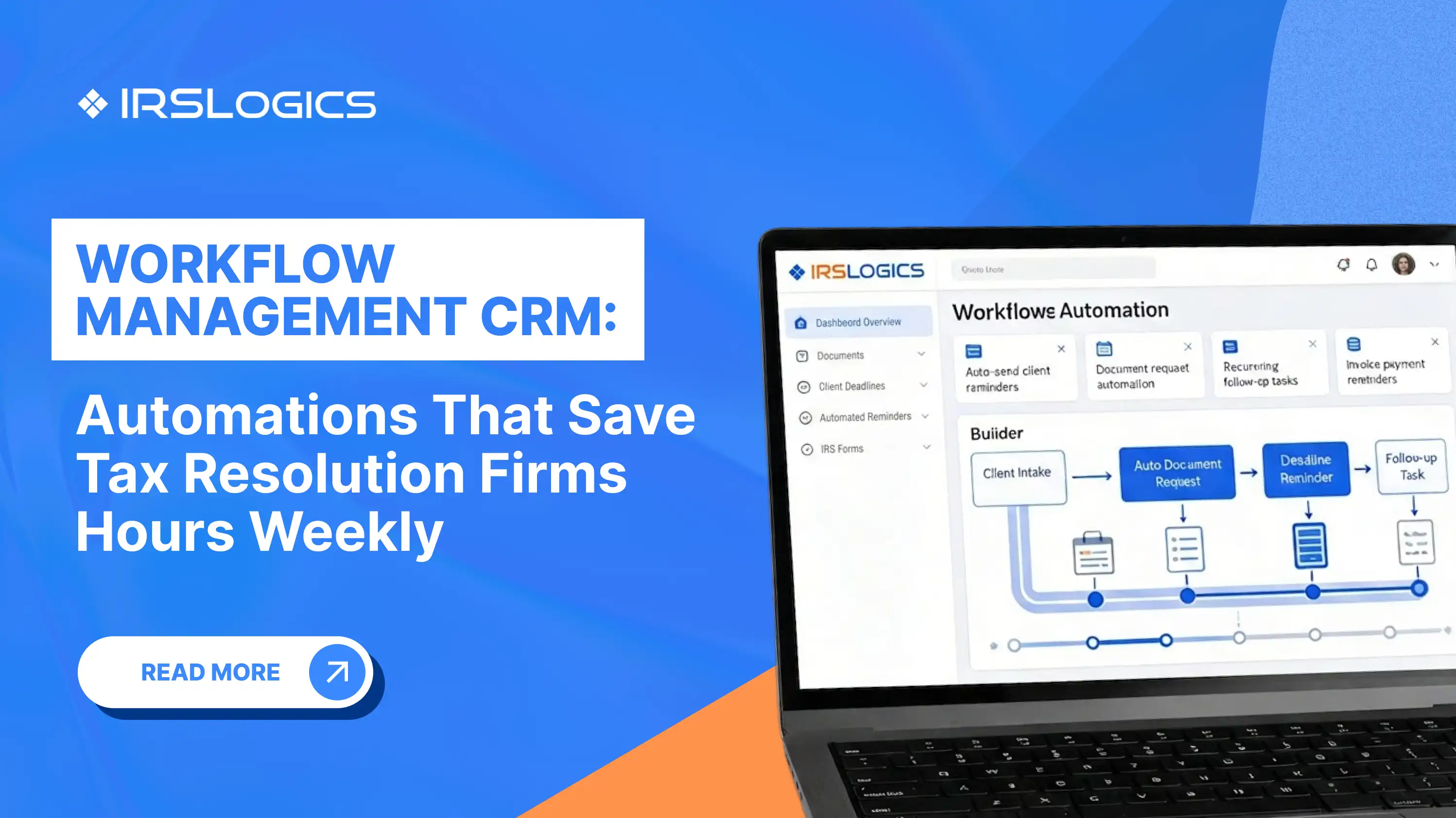
Add Accounts Receivable, Merchant Account processing, e-sign, the Client Portal, and a Rule Engine for custom automations.
That is what a tax resolution CRM with client financing looks like when your team actually uses it.
Click here to get a quote and see how it fits your firm.
It is a CRM built for IRS case work that also records how the client is paying for the engagement. Financing details sit on the case, alongside billing and services.
It gives clients who cannot pay a large retainer upfront a clear path to say yes. Fewer leads stall at the fee conversation.
IRS Logics tracks client financing on the case, such as financing through a third-party provider. It is the system of record, not the lender.
It ties financing, invoices, and payments to the same case. Your team sees unpaid balances sooner and follows up earlier.
It can store a note. But it will not connect that note to transcripts, IRS forms, or case billing the way a resolution CRM does.
Look for financing, services, invoices, and receivables visible on one case, plus IRS forms that use the same financial data.
Yes. Cloud access means sales, case managers, and billing staff see the same live record from anywhere.
Closing more cases is not about pushing harder. It is about removing the reasons good clients stall.
A tax resolution CRM with client financing gives your team one place to see the case, the payment plan, and the balance. Financing then becomes a process, not a scramble.
Questions? Call us at +1 (866) 386-2444.
Book a demo and see how IRS Logics handles financing, billing, and cases in one place.
P.S. What is the one point in your sales process where good leads go quiet?
All
Tax Software
Workflow & Automation
Industry News
Resolution Tips
Tax Resolution Marketing
Lorem ipsum dolor sit amet, consectetur adipiscing elit. Suspendisse varius enim in eros elementum tristique. Duis cursus, mi quis viverra ornare, eros dolor interdum nulla, ut commodo diam libero vitae erat. Aenean faucibus nibh et justo cursus id rutrum lorem imperdiet. Nunc ut sem vitae risus tristique posuere.


Share this article directly by email. Simply enter the recipient’s details below.

Article has been send to you.