Workflow & Automation


You know that feeling when a client asks for a case update, and you have to open four different places to piece together an answer?
That is a WIP reporting problem. And most tax resolution firms have it.
Work-in-progress (WIP) reporting lets a firm know exactly where every open case stands at any given moment. Which cases are stalled. Which staff members are over capacity. Which revenue is sitting in cases that have not moved in 60 days. For enrolled agents, tax attorneys, and CPAs managing resolution caseloads, a clean work-in-progress report is not a nice management tool. It is how you run the practice without constantly firefighting.
This blog breaks down what WIP reporting actually means for a tax resolution firm, what a good report tracks, and how to build a system that does not fall apart the moment someone goes on vacation.
In manufacturing, WIP refers to partially complete inventory. In a tax resolution firm, it refers to cases that are open and active, somewhere between intake and closure.
That sounds simple. The reality is messier.

A single tax resolution case can move through a dozen stages: intake, transcript pull, financial analysis, resolution strategy, IRS submission, response, negotiation, approval, compliance verification, closure. At any point in that journey, a case can stall because a client did not return documents, because the IRS issued a new notice, or because a team member took on too much and the case quietly slipped.
WIP reporting surfaces all of it. A work-in-progress report gives firm leadership a live snapshot of every case in motion: where it sits, who owns it, the next action, and the revenue it represents. Without that visibility, you are managing by memory and email threads. With it, you are managing a practice.
The NAEA's practice management guidance consistently points to case tracking as a foundational element of a well-run enrolled agent practice. It is not optional infrastructure. It is how firms scale without losing control of quality.
Not every WIP report is built the same way. For tax resolution firms specifically, three categories of information matter most.
Every open case should have a current stage, a current status, and a clear next action.
Stage tells you where the case sits in the resolution lifecycle: intake, investigation, strategy, filing, IRS response, compliance. Status tells you whether it is actively moving, waiting on the client, waiting on the IRS, or stuck. Next action tells you exactly what needs to happen before the case can progress.
A work-in-progress report without this level of specificity is not a report. It is a list of names. The value is in the granularity: knowing that 12 cases are waiting on client documents, 7 are waiting on IRS responses, and 3 have had no activity for 45 days and need a review.
That last category is where revenue leaks quietly. Cases that are technically open but functionally dormant show up in WIP reporting when you have stage and status tracking built into every case record.
WIP reporting without staff visibility is half a picture.
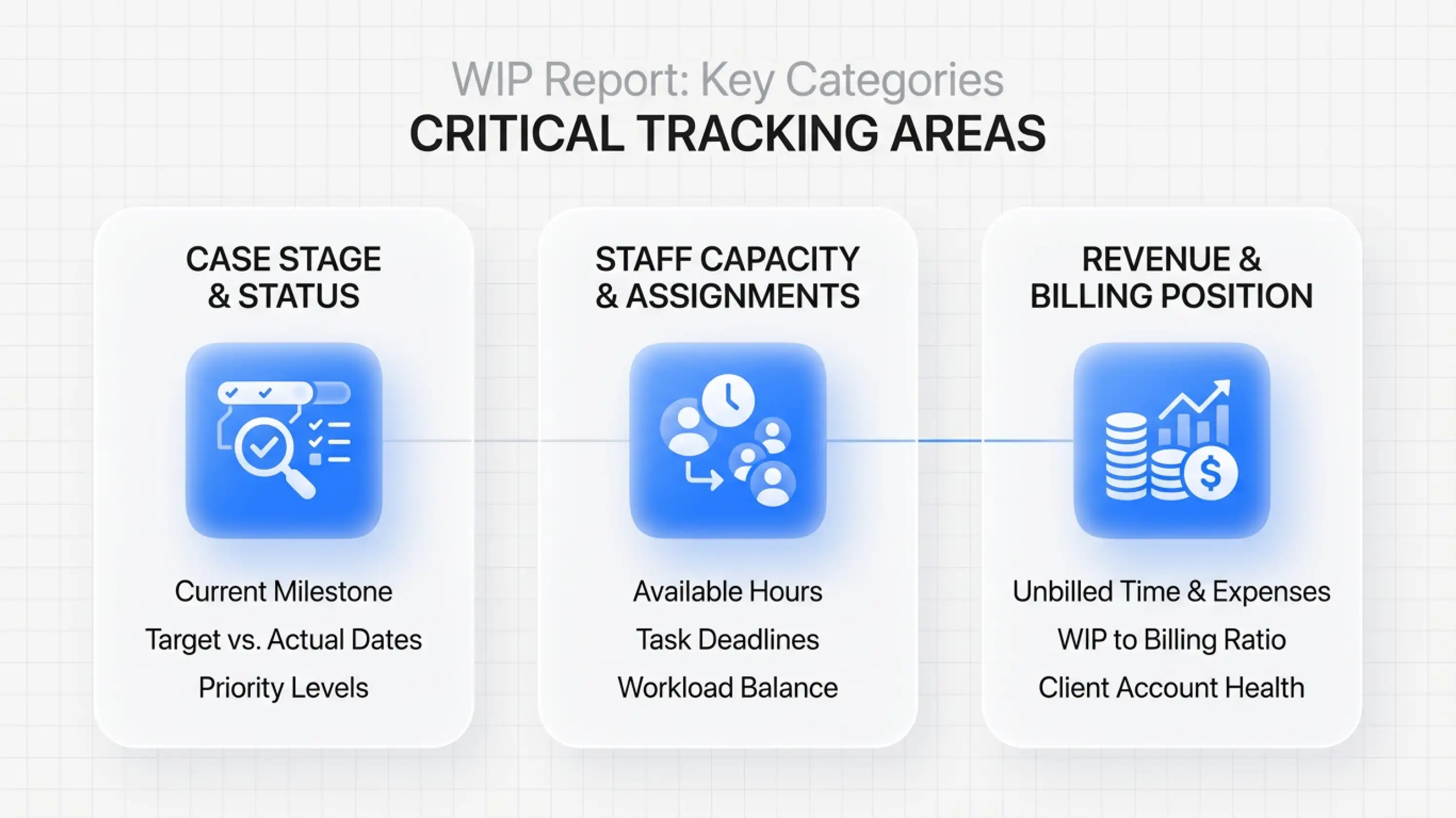
An enrolled agent running 40 active cases at the same time as a colleague running 18 is not a workload problem you can see from a case list. It only becomes visible when you map cases to assignees and look at distribution across the team.
For firms with case managers, associates, and senior practitioners, WIP reporting should show not just who owns each case, but how many cases each person owns, what stage those cases are in, and whether the distribution matches the firm's capacity model.
This matters for hiring decisions, for quality control, and for client experience. Clients whose cases sit with overloaded staff members wait longer for updates, wait longer for filings, and are more likely to feel their case is not being managed well. The American Bar Association Tax Section notes that client communication failures are among the most common triggers for bar complaints against tax attorneys. Workload visibility is part of preventing them.
Every open case has a revenue value attached to it. WIP reporting should make that visible.
How much of the contracted fee has been invoiced? How much has been collected? Are there cases where the work is largely complete but billing is behind the services rendered? Are there cases where significant fees were collected upfront but the work has barely started?
A work-in-progress report that includes billing position against case progress gives firm leadership real financial intelligence: projected revenue from active cases, collection gaps, and cases where the billing-to-work ratio is out of balance.
For firms using IRS Logics, the Billing and Invoicing features tie directly to the case record. Every invoice is linked to its case, payments are tracked to specific invoices, and the accounts receivable view shows exactly which outstanding amounts correspond to which open cases. That is WIP reporting with financial data attached, not a separate exercise.
The honest answer: because building one manually is painful and maintaining it is even harder.
Most resolution firms start with a spreadsheet. Someone builds it carefully, adds color-coding, and sets up columns for stage, status, and assignee. It works for about three weeks. Then a case manager updates one version but not another. Someone adds a new case but forgets to add it to the tracker. The IRS sends a new notice and the case status changes, but the spreadsheet still shows "waiting on client."
Within two months, nobody trusts the spreadsheet. Within four months, nobody uses it.
This is not a discipline problem. It is a design problem. A WIP report that requires manual maintenance by multiple people across multiple cases will always decay. The only WIP systems that hold are those where the report is generated from the same place where the work actually happens.
That is the distinction. If your case management system captures every action, every stage change, every document, and every billing event, your WIP report is already being built in real time. You are not maintaining a separate tracker. You are pulling a view of data that already exists.
Tax resolution firms that try to manage WIP reporting outside their case management system are doing double the work for half the visibility. IRS Logics closes that gap by keeping case data, staff assignments, and billing in one place from day one.
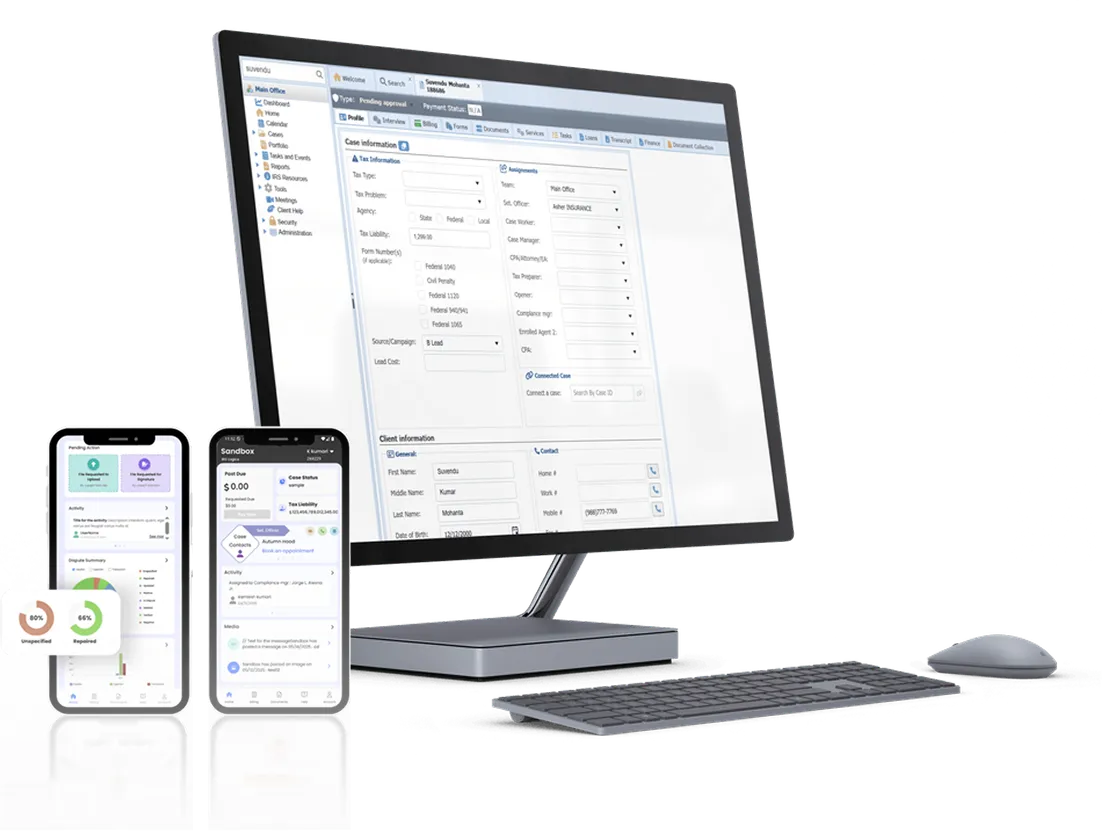
Every case in IRS Logics moves through a defined workflow, using Case Status settings configured by the firm to match its own resolution process. When a case manager updates a stage, it is logged. When a document is collected, it is logged. When a transcript is pulled, it is logged. The Case Activities feature automatically records every action taken on a case, so the work-in-progress view is always up to date without anyone manually updating a tracker.
Staff capacity visibility comes from the assignment and task structure built into every case. Firm leaders can see which case managers own which cases, what tasks are outstanding, and where workload is concentrated. The Task Summary report shows the total number of tasks assigned per team member, broken down into completed and pending, giving leadership a real staffing picture without requiring people to self-report.
On the revenue side, the Tying Payments to Invoices feature means every payment is mapped to its invoice, and every invoice is mapped to its case. The accounts receivable view becomes a live WIP report for the firm's billing position: which cases are fully collected, which have outstanding balances, and which are at risk. Book a demo to see how this works across a full caseload.
WIP stands for Work in Progress. It refers to all active cases that are still moving through the resolution process and helps firms track case status, ownership, and revenue.

A good WIP report includes the case name, current stage, assigned team member, last activity date, next action, and billing status. It should also highlight stalled cases.
A case list shows what is open. WIP reporting shows where each case stands, what is delaying it, who is responsible, and the revenue tied to it.
The best approach is to generate WIP reports directly from your case management system. Manual spreadsheets quickly become outdated and unreliable.
Yes. In accounting, WIP is generally considered a current asset because it represents work completed but not yet billed or recognized as revenue.
At least weekly. Regular reviews help identify stalled cases, balance workloads, and ensure billing stays on track.
Yes. WIP data shows team capacity, case volume, and workflow bottlenecks, making it easier to determine when additional staff are needed.
WIP reporting is not a reporting exercise. It is how a tax resolution firm simultaneously maintains control of its caseload, staff, and revenue. The firms that build this well do not just resolve cases faster. They grow without the chaos that typically comes with growth.
The starting point is a system where the work and the data live in the same place.
All
Tax Software
Workflow & Automation
Industry News
Resolution Tips
Tax Resolution Marketing
Lorem ipsum dolor sit amet, consectetur adipiscing elit. Suspendisse varius enim in eros elementum tristique. Duis cursus, mi quis viverra ornare, eros dolor interdum nulla, ut commodo diam libero vitae erat. Aenean faucibus nibh et justo cursus id rutrum lorem imperdiet. Nunc ut sem vitae risus tristique posuere.


Share this article directly by email. Simply enter the recipient’s details below.

Article has been send to you.





.webp)