Tax Software


Most tax firms don’t struggle because they lack expertise, rather they struggle because their systems were never built for the work they now do.
For years, practices invested heavily in tax prep software because returns were the product. Everything else lived in spreadsheets, inboxes, and memory. But the moment you add tax resolution or IRS representation, that model breaks down. These aren’t transactions; they're long, deadline-driven journeys that demand structured onboarding, constant updates, team coordination, and real-time visibility for partners.
Generic CRMs and tax prep suites can’t handle that complexity.
What firms need is an operating system designed around IRS cases.
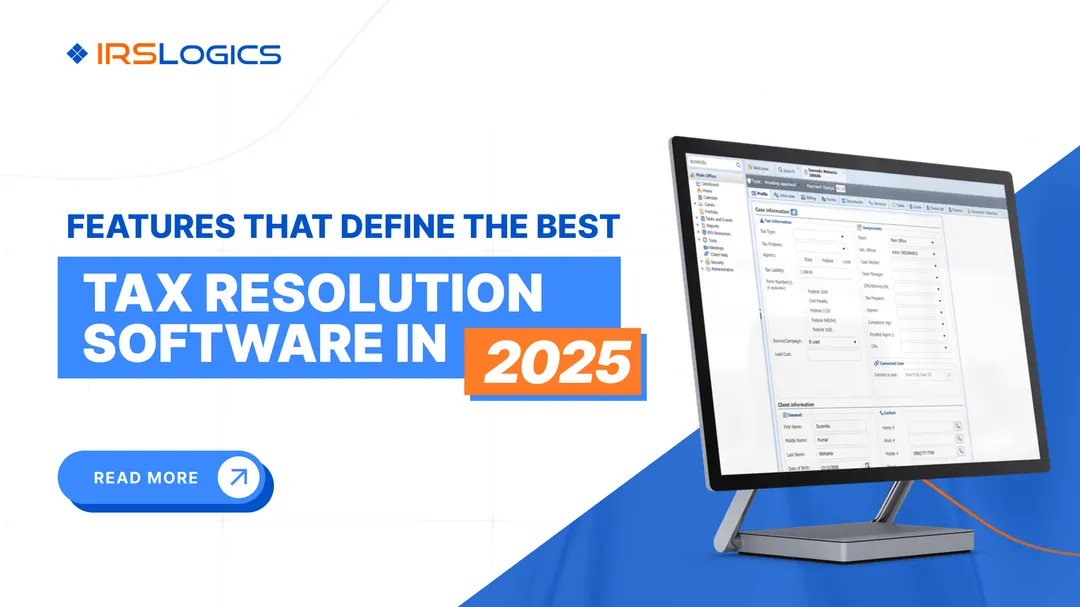
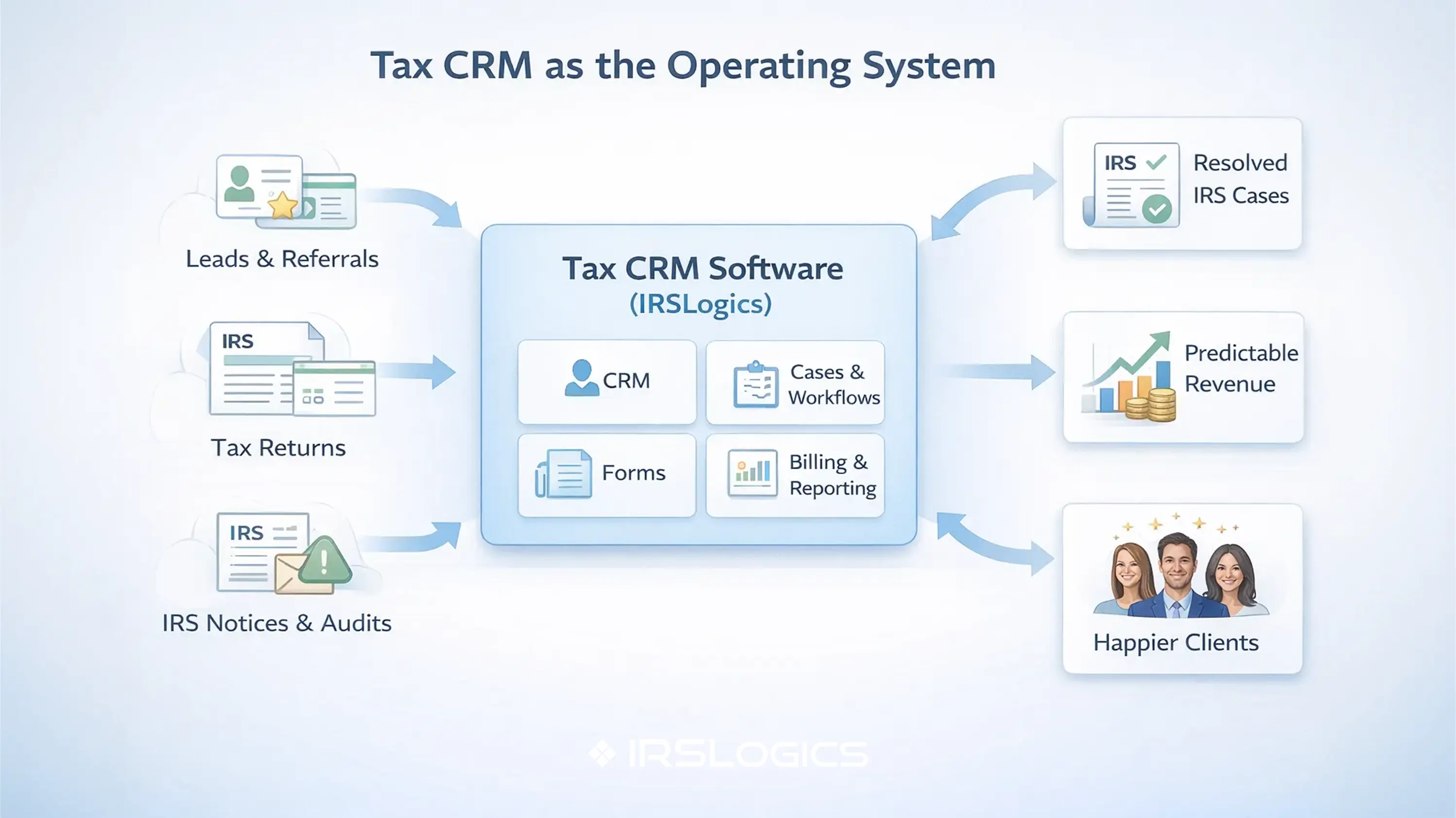
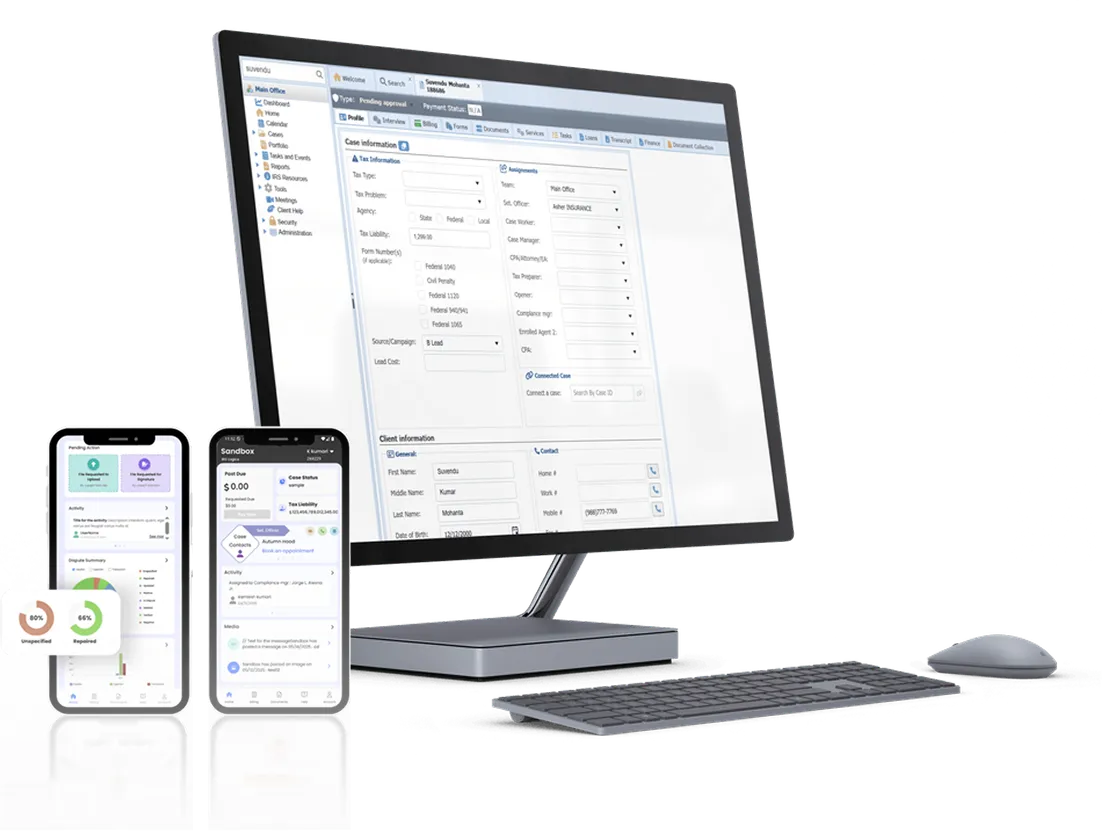
That’s where purpose-built Resolution CRM software comes in. A platform like IRSLogics unifies sales, case management, workflows, billing, and reporting running your entire tax practice from one browser-based system.
Because when your operations finally match the work you do, everything becomes easier to scale.
IRSLogics is a comprehensive, web-based CRM and case management system built exclusively for tax resolution professionals. It integrates CRM, workflow management, auto-generated IRS forms, billing and finance, reporting, e-signature and more in a browser-based platform.
Tax CRM software for professionals is a customer and practice management platform built around the realities of tax work, not generic sales cycles. At a minimum, it should help you:
Generic CRMs like Salesforce or Microsoft Dynamics can be adapted for professional services and accounting. Still, they are not natively aware of tax forms, IRS rules, or case-based resolution work.
Tax practice CRM systems such as IRSLogics and specialized tax practice platforms, take this further by:
If you are evaluating tax CRM software, look for capabilities in four main categories.
A tax practice CRM system like IRSLogics wraps all four areas into a single platform, instead of forcing you to assemble them from separate tools.
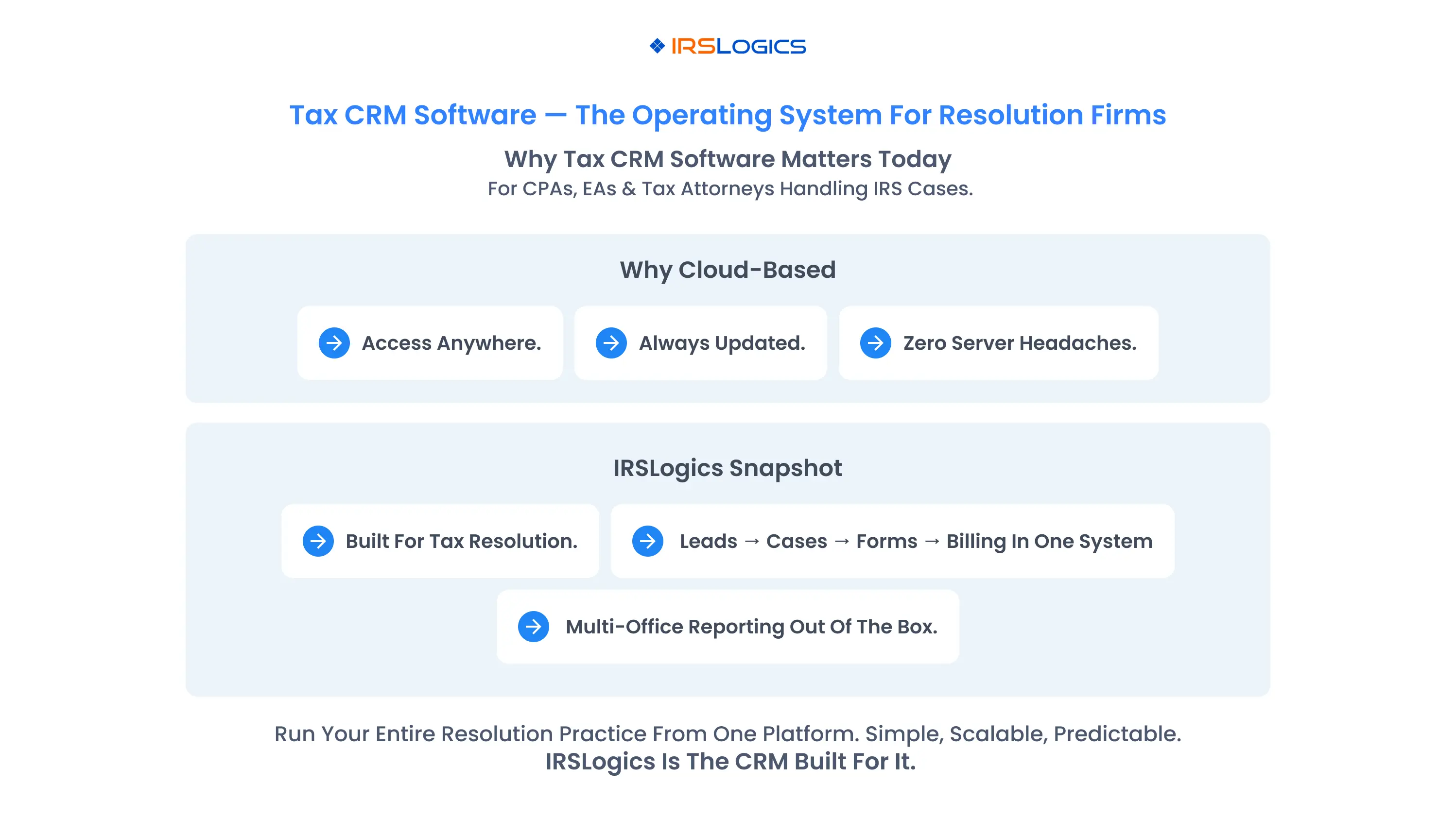
Cloud-based tax CRM has gone from “nice to have” to standard for most growth-oriented practices.
Key reasons:
For IRS-focused practices, these advantages are especially important because IRS resolution work is not seasonal. You need reliable, year-round access to cases and workflows.
IRSLogics is positioned as a complete software solution for attorneys, CPAs, enrolled agents and tax resolution firms.
Here is how it functions as tax CRM software that can run your entire practice.
IRSLogics is described in multiple directories as web-based CRM software for tax resolution firms, with strong lead management and CRM features.
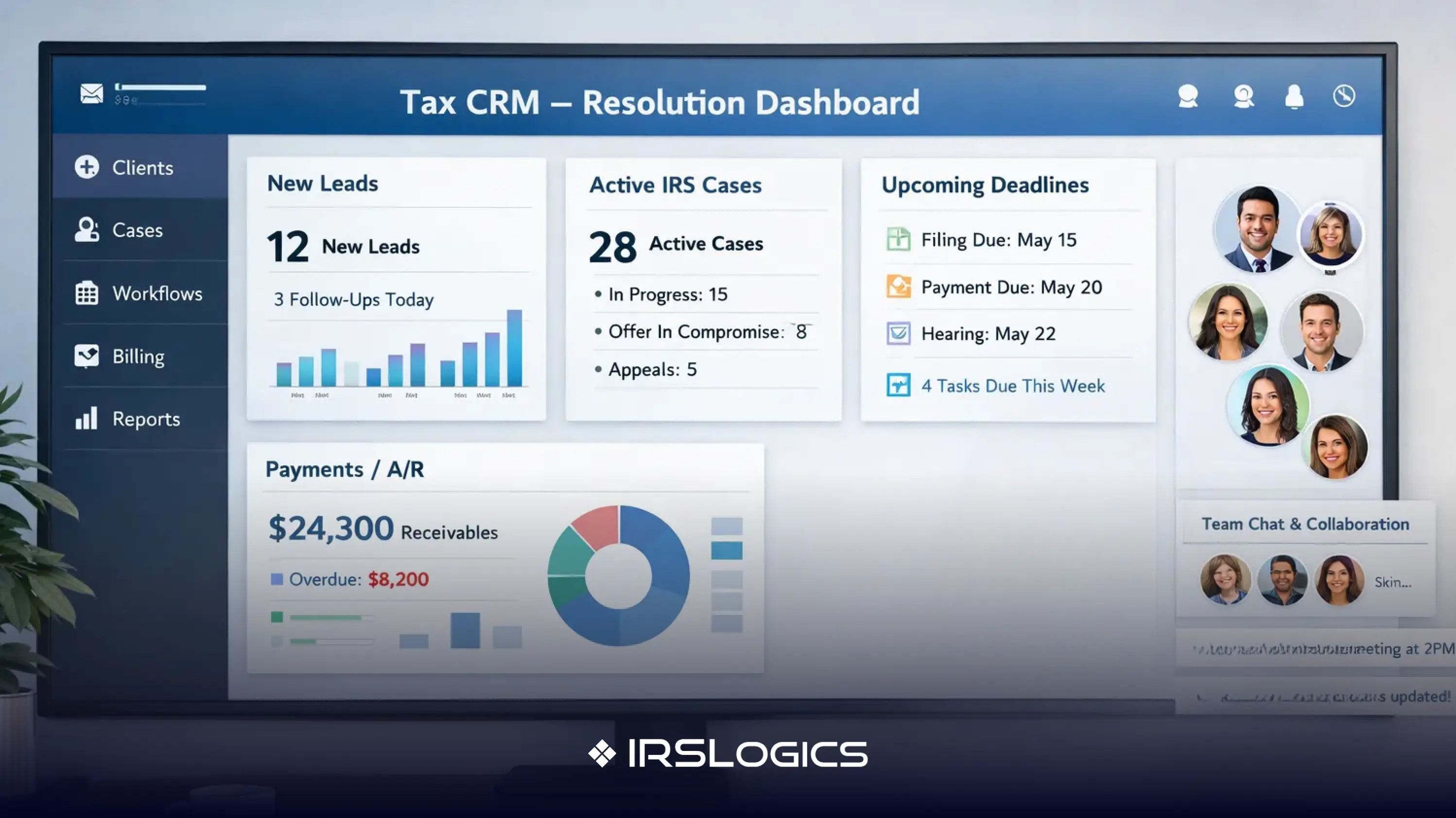
Core CRM capabilities include:
This makes IRSLogics a tax CRM software for professionals, not just a generic sales database.
Unlike general CRMs, IRSLogics includes case management and workflow capabilities explicitly built for tax resolution:
That is the difference between generic CRM software for tax practices and CRM software for tax resolution: one tracks contacts, the other runs cases.
IRSLogics integrates all current IRS and many state forms and regulations, auto-populating them from client data stored in the CRM.
For a tax resolution CRM, this matters because:
That is a major advantage over generic CRMs, which offer no native tax forms at all.
IRSLogics goes beyond CRM to include billing and finance:
On top of that, IRSLogics partners with WeGetFinancing to provide built-in client financing, allowing taxpayers to finance fees while firms get paid more predictably.
This set of features turns IRSLogics from a tax practice CRM system into a revenue infrastructure: your CRM knows what you are owed, when you should be paid, and how.
IRSLogics includes reporting and analytics for:
Because it is cloud-based and built for multi-office setups, partners can see what is happening across the entire practice from a single dashboard, rather than stitching reports together from multiple tools.
To make the most of tax CRM software like IRSLogics, treat implementation as an operational upgrade, not just a software swap.
Step 1: Map your current client and case lifecycle
Step 2: Configure CRM structures in IRSLogics
Step 3: Build tax resolution and tax prep workflows
Step 4: Integrate billing and payments
Step 5: Train your team and refine using data
Within a few cycles, IRSLogics can become the default environment where your entire team works, rather than a tool that partners only occasionally check.
Tax CRM software is no longer just a “nice-to-have contact database.” For resolution-focused firms, it becomes the engine that powers everything: client communication, IRS case workflows, documentation, billing, collections, reporting, and even multi-office visibility. It’s what keeps the practice moving forward, rather than juggling spreadsheets, inboxes, and fragmented tools.
Generic CRMs and tax prep software were never built for this world. You can customize them, bolt on add-ons, and force them to behave… but they will never truly understand the rhythm of IRS representation work.
A purpose-built Resolution CRM like IRSLogics changes that dynamic entirely. It gives CPAs, enrolled agents, and tax attorneys a single, unified system to capture and convert leads, manage complex resolution and settlement cases, automatically generate IRS and state forms, and oversee billing and revenue from one place.
And here’s the fundamental shift: the goal isn’t just to stay organized. It’s to run a practice with clarity and intention. When your technology finally works the way your firm works, your team collaborates more confidently, your clients feel guided instead of lost, and growth stops being accidental; it becomes the natural result of a system designed for the work you do best.
If your practice strategy includes growing tax resolution and IRS representation, moving to an all-in-one resolution CRM is one of the most leverage-rich changes you can make.
Tax CRM software is a customer relationship and practice management system built around how tax and accounting firms operate. It manages leads, clients, communication, workflows, documents, billing and reporting. When it is explicitly designed as CRM software for tax resolution, it also includes tax-specific case types, IRS forms and resolution workflows.
A tax resolution CRM is built for IRS notice, audit, collection and settlement work. It includes case management, tax-specific workflows, integrated IRS and state forms and billing tied to case stages. A generic CRM focuses on sales pipelines and requires heavy customization to model IRS case work.
For many resolution-focused firms, yes. IRSLogics combines CRM, case management, workflow, billing, payments, reporting and multi-office support in a single cloud-based platform. You still need separate tax preparation software for return filing, but IRSLogics can become your primary tax practice CRM system for everything around resolution, representation and client management.
Cloud-based tax CRM allows your team to log in from anywhere, keeps all offices on the same workflows, simplifies updates and reduces IT overhead. IRSLogics is fully web-based and does not require local installation, which is a major advantage over older, desktop-based systems.
No. IRSLogics serves solo practitioners and multi-office firms. It is subscription-based, per user, and is marketed as a comprehensive, web-based solution for tax resolution professionals of all sizes, with strong support and a long track record in the niche.
Most tax CRM and practice management platforms, including IRSLogics, are designed to live alongside your tax prep suite rather than replace it. You continue using your preferred tax preparation software for returns and e-filing, while the tax CRM handles CRM, case management, workflows, documents, billing and analytics.
All
Tax Software
Workflow & Automation
Industry News
Resolution Tips
Tax Resolution Marketing
Lorem ipsum dolor sit amet, consectetur adipiscing elit. Suspendisse varius enim in eros elementum tristique. Duis cursus, mi quis viverra ornare, eros dolor interdum nulla, ut commodo diam libero vitae erat. Aenean faucibus nibh et justo cursus id rutrum lorem imperdiet. Nunc ut sem vitae risus tristique posuere.


Share this article directly by email. Simply enter the recipient’s details below.

Article has been send to you.