Tax Software


Every firm has that one case manager everyone secretly relies on. The one who just knows how to handle a tricky OIC or a confused client on the phone. Great for them, terrible for you, because the day they take a vacation or leave for good, your firm's consistency walks out the door with them. That's exactly the gap tax resolution training is supposed to close.
Most firms hire for experience and then just hope the new person picks up the specifics of how things work internally. That works fine for the basics. It falls apart fast when the details actually matter, and in tax resolution, the details always matter.
A new hire who understands general tax prep still needs real tax resolution training before they're ready to handle an OIC qualification call or explain a CSED timeline to a panicked client. The skills don't automatically transfer. Someone can be excellent at bookkeeping and still have no idea how to structure a financial questionnaire for an Offer in Compromise, and that gap shows up at the worst possible time, usually mid-case.
Firms that skip structured tax resolution training end up with wildly inconsistent case handling. One case manager documents everything meticulously. Another barely logs a phone call. One follows the intake script closely. Another improvises and misses a key qualifying question. None of this is anyone's fault exactly. It's what happens when training is left to whoever happens to be free that week, which is exactly the kind of gap the firms we work with, described on our about page, are usually trying to close.
Good IRS tax resolution training isn't just a PDF handed to a new hire on day one. It needs to cover the actual mechanics of the work, not just the theory behind it.
At minimum, IRS tax resolution training should include:

Skip any of these, and you're setting a new hire up to learn through mistakes, which usually means a client learns through those mistakes too. Proper IRS tax resolution training front-loads the hard lessons so they happen in a controlled setting, not on a live case with real money and real deadlines attached. Our FAQ page covers a few more specifics firms often ask about when building this out for the first time.
There's no single right answer here, but rushing it is almost always a mistake. Tax resolution staff training that gets compressed into a single afternoon tends to produce case managers who are confident but not actually competent, which is a dangerous combination.
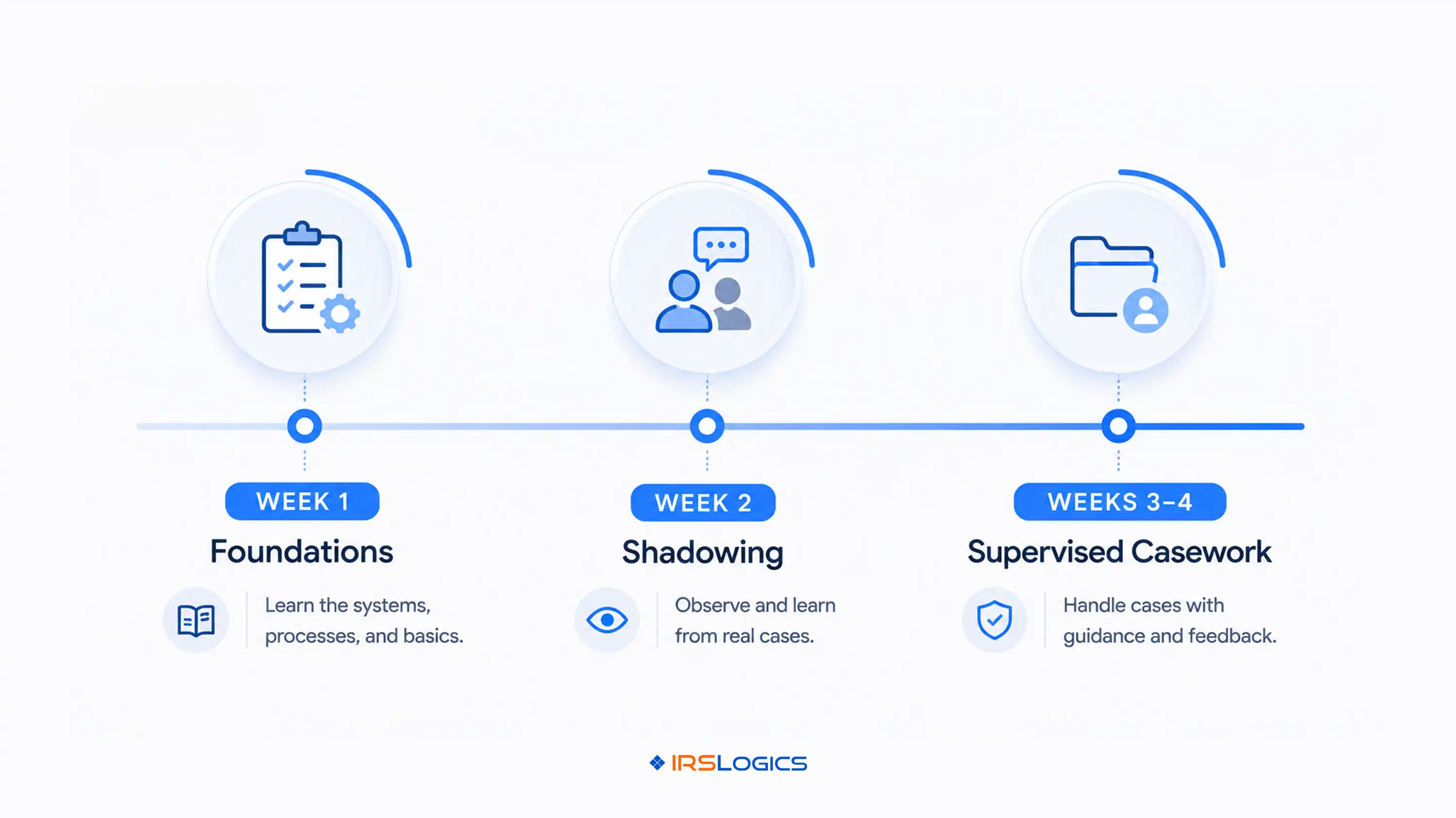
A reasonable structure looks something like this. The first week covers foundational knowledge, IRS notice types, resolution paths, and the basic case lifecycle. The second week moves into shadowing, where the new hire sits in on real calls and watches how an experienced case manager handles intake, objections, and follow-up. By week three or four, they're handling supervised cases directly, with someone reviewing their work before anything goes out the door.
Firms that stretch tax resolution staff training over several weeks instead of cramming it into a few days consistently end up with case managers who make fewer errors down the line. It costs more time upfront. It saves considerably more time in corrected mistakes and unhappy clients later.
The mistakes are rarely dramatic. They're small, repeated, and quietly expensive.
A new hire might miss that a client already has an active installment agreement, and accidentally recommend a conflicting resolution path. They might forget to verify a CSED date before promising a client a timeline that isn't actually realistic. They might fill out a financial questionnaire incompletely, which then delays an OIC submission by weeks while someone chases down the missing information.
None of these mistakes come from carelessness. They come from not knowing what to check, because nobody walked them through it properly. This is the real cost of skipping tax resolution training. It's not one catastrophic failure. It's a hundred small ones that quietly erode client trust and case timelines, the same erosion we describe in our piece on what happens when firms don't use IRS notice tracking software.
The firms that get this right treat tax resolution training as a system, not a one-time event tied to whoever happens to be onboarding that month.
Start with a written intake script that covers the exact questions every new client call needs to answer. Build a simple checklist for each resolution path, OIC, installment agreement, CNC, so nothing gets skipped regardless of who's handling the case. Record a few real case walkthroughs, anonymized, so new hires can see how an experienced case manager actually thinks through a decision, not just what the final paperwork looked like.
Then, and this part gets skipped constantly, revisit the training material every few months. IRS rules shift. Forms get updated. What worked as tax resolution training material last year might already be slightly out of date, and nobody wants a new hire learning outdated procedures with total confidence. Our blog covers other operational topics worth folding into that regular review.
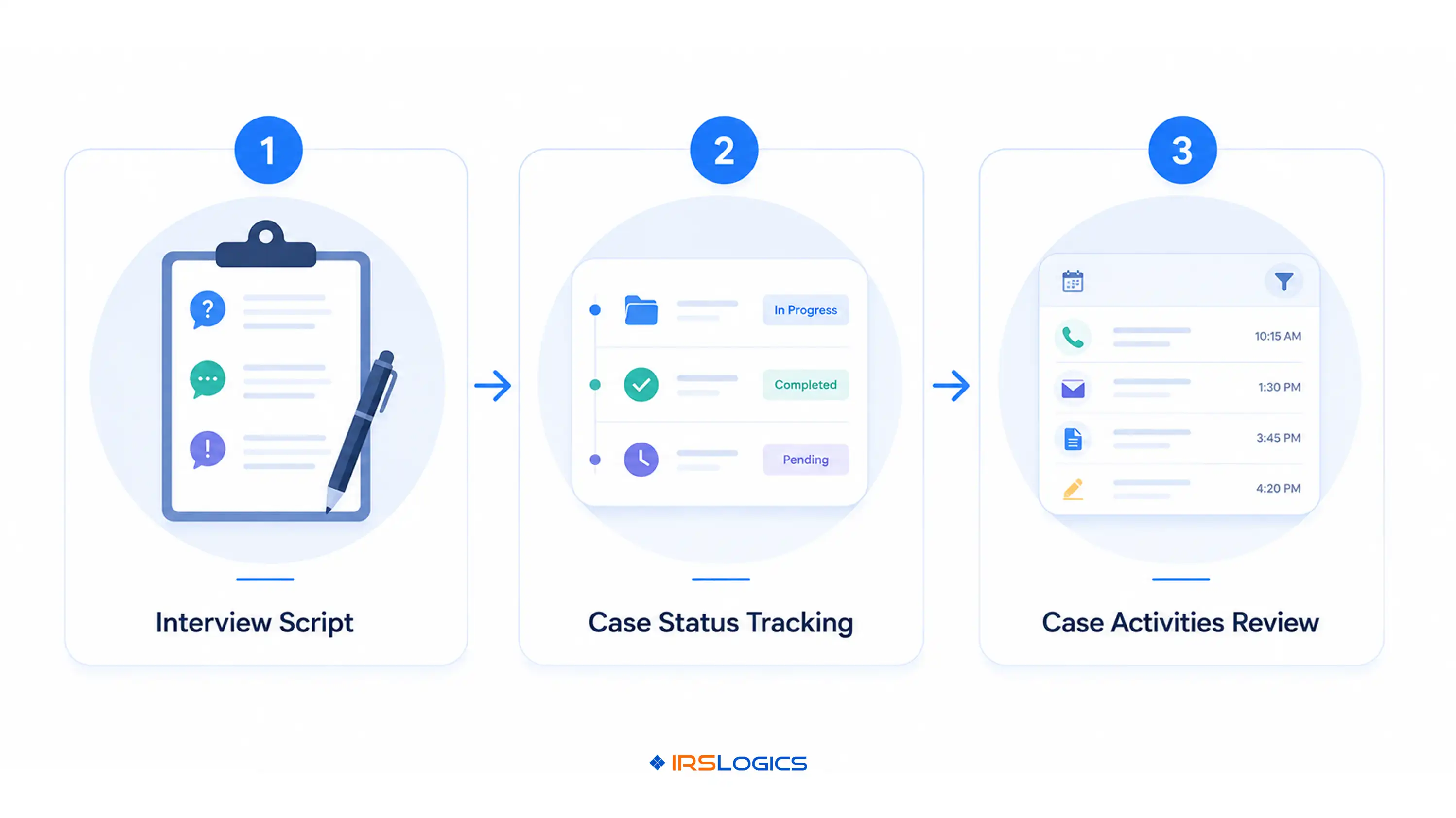
This is where the right software actually makes training easier, not just case handling. The Interview Script feature lets firms build custom scripts for client intake calls, which means a brand new case manager is working from the exact same structured questions as your most experienced one, not improvising based on what they half remember from onboarding. You can see how this connects to broader intake consistency in our piece on what a proper tax CRM should track for resolution work.
Case Status can be customized to reflect your firm's actual workflow stages, so new hires always know exactly where a case stands and what the next step should be, without guessing. Case Activities logs every action automatically, which turns real, anonymized cases into genuinely useful training material later, since supervisors can review exactly what a new hire did and where they got stuck. Roles and Permissions let firms control what new hires can access while they're still learning, so a trainee reviewing a case can't accidentally submit something that should go through a supervisor first. If you want to see how this fits into a broader evaluation, our pricing page and features overview lay out exactly what's included.
None of this replaces actual human training. It just gives your training program something solid to stand on, so new hires are learning the real process, not a slightly different version of it depending on who happened to train them. Want to see how this looks for your specific team structure? Book a demo, and we'll walk through it.
Most firms see solid results with a three to four week structure, moving from foundational knowledge through shadowing and into supervised casework before full independence.
IRS tax resolution training focuses specifically on resolution mechanics, OIC qualification, transcript interpretation, and case documentation, which general tax prep training typically doesn't cover at all.
Yes, especially around firm specific workflows and any recent IRS rule changes. Experience in the field doesn't automatically mean familiarity with your firm's exact process.
Case handling becomes inconsistent, with some case managers documenting thoroughly and others missing key steps, which eventually shows up as client complaints or delayed filings.
Yes. IRS rules and forms change regularly, so tax resolution training material should be reviewed and updated every few months to stay accurate.
Very much so. Watching how an experienced case manager handles real client objections and edge cases teaches things a written script alone can't.
A firm that relies on one or two people to hold all the institutional knowledge isn't actually stable; it just feels that way until someone leaves. Real tax resolution training turns individual expertise into a repeatable system the whole team can follow, which means your firm's consistency doesn't depend on any single person showing up that day.
Ready to build a training process your whole team can rely on? Get in touch and see how IRS Logics supports consistent onboarding and case handling.
All
Tax Software
Workflow & Automation
Industry News
Resolution Tips
Tax Resolution Marketing

Lorem ipsum dolor sit amet, consectetur adipiscing elit. Suspendisse varius enim in eros elementum tristique. Duis cursus, mi quis viverra ornare, eros dolor interdum nulla, ut commodo diam libero vitae erat. Aenean faucibus nibh et justo cursus id rutrum lorem imperdiet. Nunc ut sem vitae risus tristique posuere.


Share this article directly by email. Simply enter the recipient’s details below.

Article has been send to you.