Workflow & Automation


There is a moment every growing tax resolution firm hits.
Cases are up. Revenue is up. The team is bigger. And somehow, everything feels harder to manage than when you had half the clients.
You are chasing the same documents twice. Someone's payment is applied to the wrong invoice. A transcript pull happened, but no one logged it. A case manager emails you asking where a client's 433-A data is, and it is in three different places.
The firm is not broken. The workflow is.
And usually, that is when someone starts searching for the best tax workflow software, hoping a single platform will quiet the chaos.
But here is the problem nobody talks about: most tax workflow software was not built for resolution work. It was built for tax preparation. For returns. For seasonal firms that need to move 400 1040s from January to April and then breathe for eight months.
Resolution is a completely different job. And the software has to match the job.
Workflow software, in any industry, exists to answer one question: what happens next, and who is responsible for it?
In a tax prep firm, that question has a fairly predictable answer. Client sends documents. Preparer builds the return. Reviewer checks it. Return goes out. Rinse and repeat.
In a resolution firm, the answer changes with every case. One client needs an Offer in Compromise. Another needs an installment agreement. A third came in for an OIC, but after transcripts came back, Currently Not Collectible is the better path. Each of those has a different document list, a different IRS form set, different timelines, and different client communication requirements.
Generic tax workflow software manages a pipeline. The best tax workflow software for resolution firms manages a case lifecycle, and those are not the same thing.
A resolution-ready workflow platform needs to do five things well:
Move cases through defined stages without things falling through
Every resolution case has stages: intake, financial assessment, transcript review, resolution analysis, form preparation, IRS submission, follow-up, and close. The software needs to mirror that structure, not force you to build workarounds inside a generic pipeline.
Connect transcript data to the case, not just a folder
Pulling transcripts is not the hard part. Knowing which transcript was pulled for which year, when it was last updated, and how it feeds into the OIC or IA calculation is the hard part. The best tax resolution workflows pull transcripts inside the case record, log them automatically, and let the data flow downstream.
Turn client financial data into IRS forms without manual re-entry
The financial questionnaire moment is where most workflow software breaks down. A client fills out their income and expenses. Someone on your team re-enters that data into Form 433-A. Then re-enters it again into the OIC worksheet. Then again into the engagement letter.
That is three opportunities for errors in the data that the IRS will scrutinize closely. Good tax workflow software eliminates the re-entry entirely.
Keep billing connected to the case
Resolution cases run for months. Sometimes years. Retainers, milestone invoices, recurring payments the billing picture is complex. If your billing tool lives separately from your case management system, you will always be reconciling rather than managing.
Give clients a structured, secure channel for everything
Email threads for document collection. WhatsApp for quick questions. DocuSign links emailed at 6 PM. The scattered communication model is a workflow problem, not a client relationship problem. The platform needs to hold client communication together in one place.
Here is an uncomfortable truth.
Most platforms marketed as tax workflow software are built around the prep firm model. They handle task assignments, deadline tracking, client communication, and document storage. And they do those things well, for general accounting work.
But when you try to run resolution cases through them, the gaps appear fast.
Canopy and TaxDome are frequently mentioned in workflow software comparisons. Both are strong practice management platforms. Both handle document management, client portals, task workflows, and billing. Neither was built with the resolution case lifecycle as the organizing principle. Transcript integration, OIC calculators, 433-A auto-population, and installment agreement tracking are add-ons in a general platform. In a resolution-first platform, they are the core.
For enrolled agents managing complex OIC and IA cases, that distinction is not a minor preference. It is the difference between a tool that removes friction and one that creates new friction elsewhere.
The question to ask any software vendor is not "does it have workflow features?" Everything has workflow features. The question is: does the workflow map to how an IRS resolution case actually moves?
If the answer involves significant customization to make a general tool fit a resolution firm, that is your answer.
Before you book a demo with anyone, here is the checklist that matters:
Transcript retrieval inside the case record, logged and timestamped
Not a separate browser tab. Not a PDF download you attach manually. The transcript pull should occur within the platform, be automatically attached to the case, and log the date, type, and year in the case activity trail.
Financial questionnaire that auto-populates IRS forms
The client fills it out once. The data flows into Form 433-A, 433-B, and OIC worksheets without anyone re-typing it. If the software makes you re-enter this data, it is creating risk, not removing it.
Resolution-path workflows for OIC, IA, CNC, and penalty abatement
Each path has different requirements. The workflow should reflect that, rather than giving you a generic "case" template you have to reshape for every case type.
Role-based access and case activity logs
Who touched this case? When? What did they do? For multi-staff firms, the audit trail is not a compliance checkbox. It is how case managers stay coordinated, and partners stay informed without scheduling another status call.
Billing tied to case milestones
Payments linked to specific invoices inside the case record. Not reconciled from a separate billing tool at the end of the month. Real-time clarity on what has been paid, what is outstanding, and which stage of the case it corresponds to.
A client portal that is part of the case, not a separate product
When a client uploads a document through the portal, it should be added to their case record. When they make a payment, it should update the invoice in the billing module. If the portal lives in a separate product, you are managing two systems instead of one.
Tax resolution teams that try to run their workflows through general practice management tools will eventually hit the same wall. The tools are not wrong. They are just not built for this.
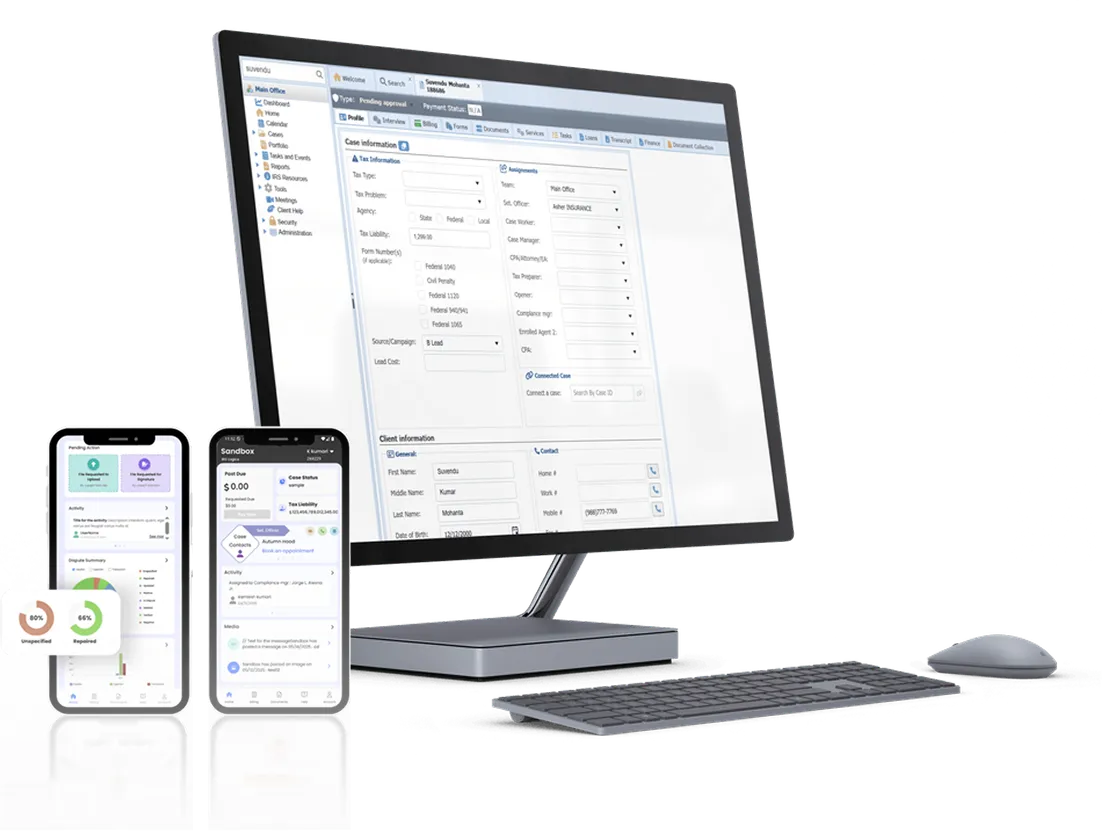
IRS Logics was built from the ground up for tax resolution professionals, and the workflow architecture reflects that. Every feature maps to a stage in the IRS case lifecycle, from the first intake call to final resolution and case closure.
The Financial Questionnaire sends a fillable digital form to the client. When they complete it, the data auto-populates directly into Form 433-A, Form 433-B, and OIC worksheets inside the platform. The Document Collection workflow tracks every file with clear status visibility, so case managers always know what has arrived and what is still outstanding. Transcript retrieval occurs within the case record and is logged automatically, with every pull tied to the relevant case and year. Payments link directly to their specific invoices, so accounts receivable is always accurate without a reconciliation session at the end of the billing cycle.
Firms running multi-staff resolution practices at volume use IRS Logic because the platform keeps cases together. One record. Every action logged. Every team member sees exactly what they need to see and nothing they should not. The rule engine allows custom automations so the workflow reflects how your firm actually operates, not how a software company assumed you would.
When the question is which is the best tax workflow software for resolution work, the answer is not the platform with the longest feature list. It is the platform where the workflow was designed around IRS cases from the beginning.
See how IRS Logics runs resolution workflows from intake to close.
Tax workflow software manages tasks, documents, and client communication across a tax practice. Tax resolution software is built specifically for IRS resolution work, including transcripts, Form 433 workflows, OIC management, and case tracking.
General platforms can manage basic workflows well. However, firms handling tax resolution at scale often need resolution-specific features like transcript integration, Form 433 automation, and OIC tools that are built into specialized platforms.
Financial data auto-population. When client financial information automatically flows into Form 433s and related IRS forms, firms save time, reduce errors, and move cases faster.
Very important. Resolution cases often involve retainers, payment plans, and milestone billing. Keeping billing inside the case management system improves visibility and reduces administrative work.
No. IRS systems remain the official source. Tax workflow software simply integrates with them, making transcript retrieval and case management more efficient.
Ask whether transcripts, client financial data, and billing all live inside the same case record. If the answer involves manual workarounds or multiple systems, the platform was likely adapted rather than built for tax resolution.
The chaos that comes with a growing resolution firm is not a staffing problem or a capacity problem. It is almost always a workflow problem.
The right tax workflow software does not just organize tasks. It removes the re-entry, connects the data, maps the case stages, and gives every person on the team exactly what they need to move their part of the case forward.
For IRS resolution work specifically, that software needs to be built for resolution. Not adapted from something else. Not close enough with a few workarounds. Built for it.
That is a short list. And for firms that have found it, the difference is hard to overstate.
All
Tax Software
Workflow & Automation
Industry News
Resolution Tips
Tax Resolution Marketing
Lorem ipsum dolor sit amet, consectetur adipiscing elit. Suspendisse varius enim in eros elementum tristique. Duis cursus, mi quis viverra ornare, eros dolor interdum nulla, ut commodo diam libero vitae erat. Aenean faucibus nibh et justo cursus id rutrum lorem imperdiet. Nunc ut sem vitae risus tristique posuere.


Share this article directly by email. Simply enter the recipient’s details below.

Article has been send to you.



.webp)