Workflow & Automation


Picture the moment your case manager hits submit on an OIC package, leans back, and finally exhales. Then three weeks later, an IRS rejection letter lands. The reason? A single missing line item on the Form 433-B. Cue the groan heard across the office. If you've lived this exact scene, you already know why getting Form 433-B instructions right the first time isn't optional; it's survival.
Here's the twist most new case managers don't see coming. Form 433-B looks simple on the surface, just another government form with boxes to fill in. Then you actually sit down with a business owner, and suddenly you're untangling commingled personal and business expenses, chasing down three months of missing bank statements, and realizing the "quick call" just became a two-hour excavation project.
Form 433-B is the IRS's business collection information statement, used to evaluate a business's ability to pay outstanding tax debt. It covers assets, income, expenses, and liabilities for the business itself, separate from the owner's personal finances covered on a Form 433-A. Sounds straightforward. It rarely is, mostly because business finances are messier than personal ones, and one overlooked detail can stall an entire resolution case. This is the exact kind of complexity the firms on our about page deal with daily, which is why intake accuracy matters so much.
Let's break the drama down into something manageable, because that's really what good Form 433-B instructions should do.
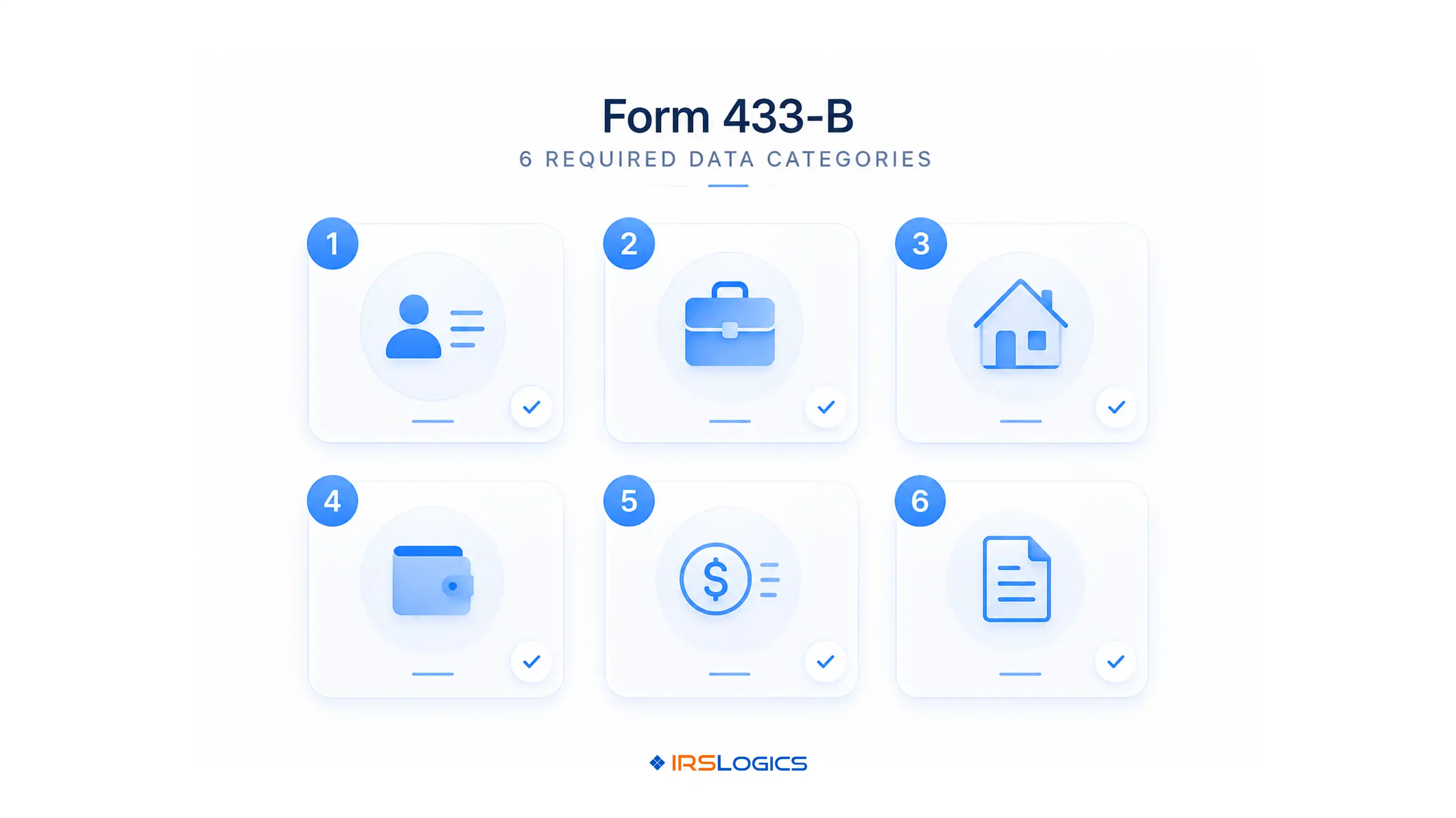
The form asks for a full picture of the business, not a summary. That includes:

Following accurate Form 433-B instructions matters because the IRS is essentially building a financial snapshot to determine what the business can realistically afford to pay. Miss a section, round a number generously, or leave a liability off the page, and you're not just risking a rejection. You're risking a client's trust in your firm's competence. Our FAQ page covers a few more specifics on how firms typically handle edge cases here.
Think of the business collection information statement as the IRS's version of due diligence. Before approving an Offer in Compromise, an installment agreement, or Currently Not Collectible status for a business, the IRS wants proof, not promises.
The business collection information statement gets compared against tax filings, bank records, and sometimes third-party data the IRS already has access to. If the numbers on your business collection information statement don't line up with what the IRS can independently verify, that mismatch becomes a red flag, and red flags mean delays, additional document requests, or outright denial.
This is exactly why treating the business collection information statement as a formality is such a dangerous mistake. It's not paperwork for paperwork's sake. It's the document the IRS uses to decide whether your client's business gets relief or gets pushed back into collections. Our guide on what tax resolution software should include for CPAs covers more on how firms build accuracy into every stage of this process.
Here's where the plot really thickens. Business financials rarely arrive clean. A client hands over a shoebox of receipts, or worse, tells you "it's all in QuickBooks" without mentioning that half the categories are miscoded. Someone on your team manually keys numbers from a bank statement into Form 433-B. Then a week later, the client remembers a business loan they forgot to mention, and suddenly that same data needs re-entering, again.
This cycle of re-entry is where firms lose real hours. Every time information gets typed once for intake, then re-typed onto Form 433-B, then corrected because a number changed, the odds of a small error creeping in go up. And small errors on a business collection information statement don't stay small. They become the reason a case sits in review for an extra six weeks while the IRS asks for clarification. It's worth weighing those lost hours against actual pricing before assuming manual entry is somehow the cheaper option.
The fix isn't working harder. It's removing the repetition entirely, so the same piece of information only ever gets entered once.
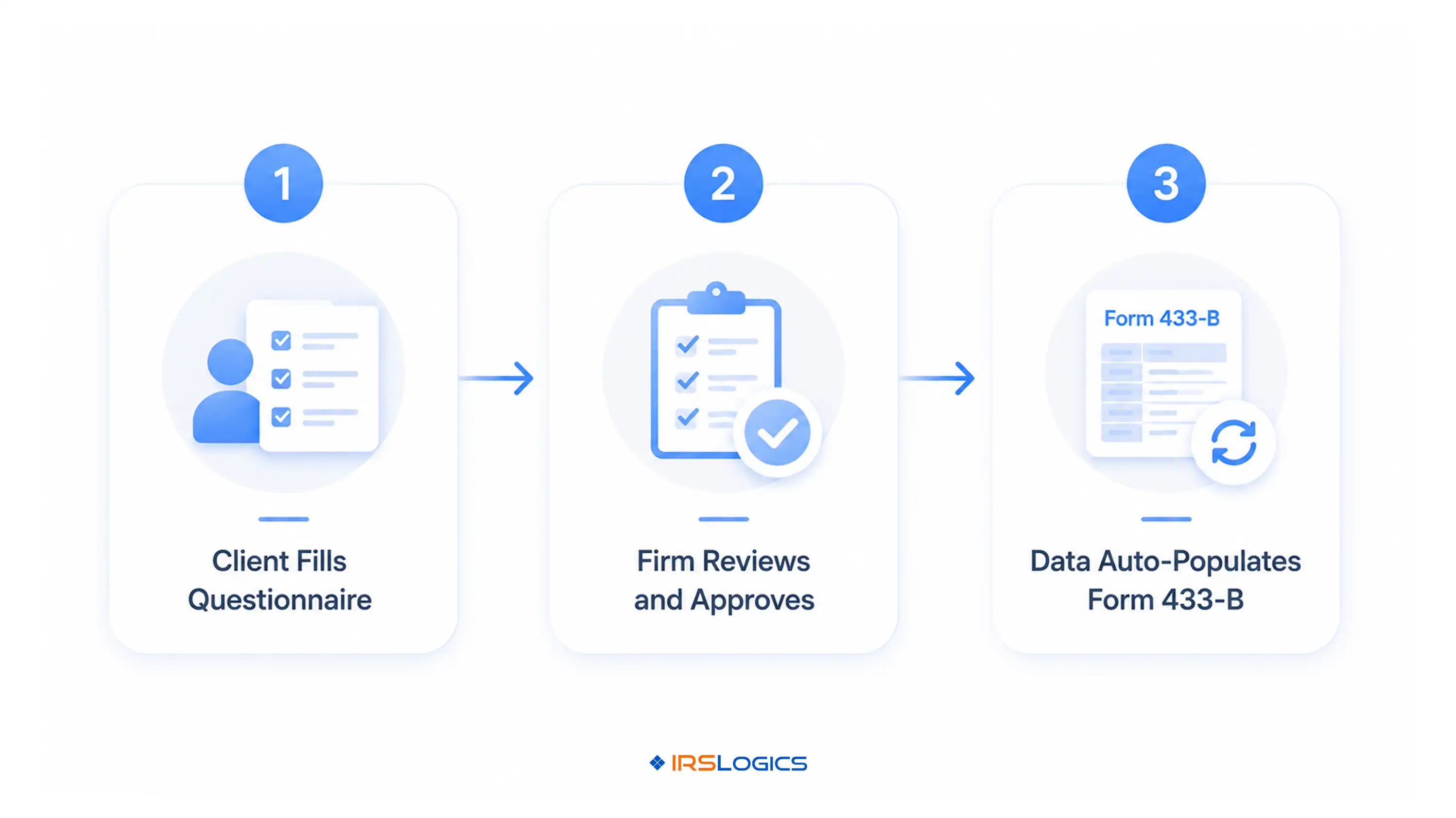
Start by sending the client a structured financial questionnaire before the first real meeting, not asking them to show up with vague documents and hope for the best. Build the questionnaire around the exact categories Form 433-B needs: business bank balances, receivables, assets, liabilities, so nothing gets collected in a format that has to be reformatted later. Once the client submits it, that data should flow directly into the form itself, not get manually transcribed by a case manager squinting at a PDF.
This single change, moving from manual re-entry to a direct pipeline from client input to finished form, is usually the difference between a Form 433-B that takes twenty minutes to finalize and one that eats an entire afternoon.
This is where the story gets its happy ending. The Financial Questionnaire feature sends a fillable intake form directly to the client. They complete it, your firm gets notified, someone reviews and approves it, and the data auto-populates directly into the Form 433-B, along with the Form 433-A and OIC worksheets where relevant. No re-typing. No squinting at handwritten notes. No copying numbers from one screen to another and hoping nothing gets fat-fingered along the way.
The Forms module keeps every federal and state form, including Form 433-B, built directly into the platform, so your team isn't hunting for the latest version on the IRS website or working from an outdated PDF sitting in someone's downloads folder. If a client's situation calls for a custom form, merge fields let your firm build that in too, without breaking the same auto-population workflow. You can see the full feature set, along with how this fits into the bigger picture of intake efficiency, in our piece on what a proper tax CRM should track for resolution work.
For firms handling business resolution cases regularly, this isn't a small convenience. It's the difference between a case manager finishing a Form 433-B in one sitting versus reopening it three separate times because something changed or something got missed. Our blog has more breakdowns like this one if you want to dig deeper before deciding. If you want to see exactly how the questionnaire connects to the finished form, book a demo and watch a real business case walk through it start to finish.
Form 433-B is the IRS's business collection information statement, used to evaluate a business's financial situation before approving an Offer in Compromise, installment agreement, or Currently Not Collectible status.
Form 433-B covers business finances, assets, income, and liabilities. Form 433-A covers the individual taxpayer's personal financial situation, and both are often required together for business owners.
You'll typically need recent business bank statements, a list of business assets, accounts receivable records, and details on outstanding business liabilities like loans.
Rejections usually happen when reported figures don't match what the IRS can independently verify through tax filings or third party financial data, or when required sections are incomplete.
Yes, if the intake process is structured well from the start. Collecting complete financial data upfront through a proper questionnaire avoids repeated follow-up requests later.
With clean, complete financial data on hand, most case managers can finalize an accurate Form 433-B in well under an hour, compared to several hours or days when data has to be chased down piecemeal.
Form 433-B doesn't have to be the form everyone dreads. The tension, the rejections, the late-night re-entry sessions, none of that is inevitable. Get the intake process right, keep the data flowing in one direction instead of bouncing between spreadsheets and forms, and the business collection information statement becomes just another completed step instead of the thing that stalls your whole case.
Ready to stop re-entering the same business financials three times? Talk to our team and see how IRS Logics turns intake into a finished Form 433-B automatically.
All
Tax Software
Workflow & Automation
Industry News
Resolution Tips
Tax Resolution Marketing
Lorem ipsum dolor sit amet, consectetur adipiscing elit. Suspendisse varius enim in eros elementum tristique. Duis cursus, mi quis viverra ornare, eros dolor interdum nulla, ut commodo diam libero vitae erat. Aenean faucibus nibh et justo cursus id rutrum lorem imperdiet. Nunc ut sem vitae risus tristique posuere.


Share this article directly by email. Simply enter the recipient’s details below.

Article has been send to you.