Workflow & Automation


A client calls on a Tuesday afternoon. Payroll tax notices going back three years. A stack of 941s nobody can find. An IRS revenue officer already assigned to the case. And your team is staring at a shared drive folder named "Mike_Final_FINAL_v3."
This is not a rare story. For enrolled agents and tax attorneys handling IRS resolution work, it is practically a Monday morning.
The difference between a firm that resolves this case cleanly and a firm that drowns in it often comes down to one thing: how they organized the client's business tax information before the real work began. A strong business tax organizer is not paperwork for paperwork's sake. It is the structure that makes every IRS interaction faster, every form more accurate, and every resolution path clearer.
This checklist covers what belongs in a complete business tax organizer for payroll tax and IRS resolution cases, and how to run that process without losing your mind.
Individual resolution cases are complex. Business payroll tax cases are a different category entirely.
You are dealing with Trust Fund Recovery Penalties that can pierce the corporate veil and attach to individual officers. You are coordinating Form 941 filings across multiple quarters, cross-referencing them against IRS transcripts that do not always match what the client believes they filed. You are potentially looking at a Revenue Officer who has already started collection action.
In that environment, "we will gather documents as we go" is not a strategy. It is a liability.
A structured business tax organizer forces the critical questions to the surface early: Who are the responsible parties? What periods are in dispute? Is the entity still operating? What payroll provider was involved, and are those records accessible?
Get those answers on day one. Everything after that moves faster.
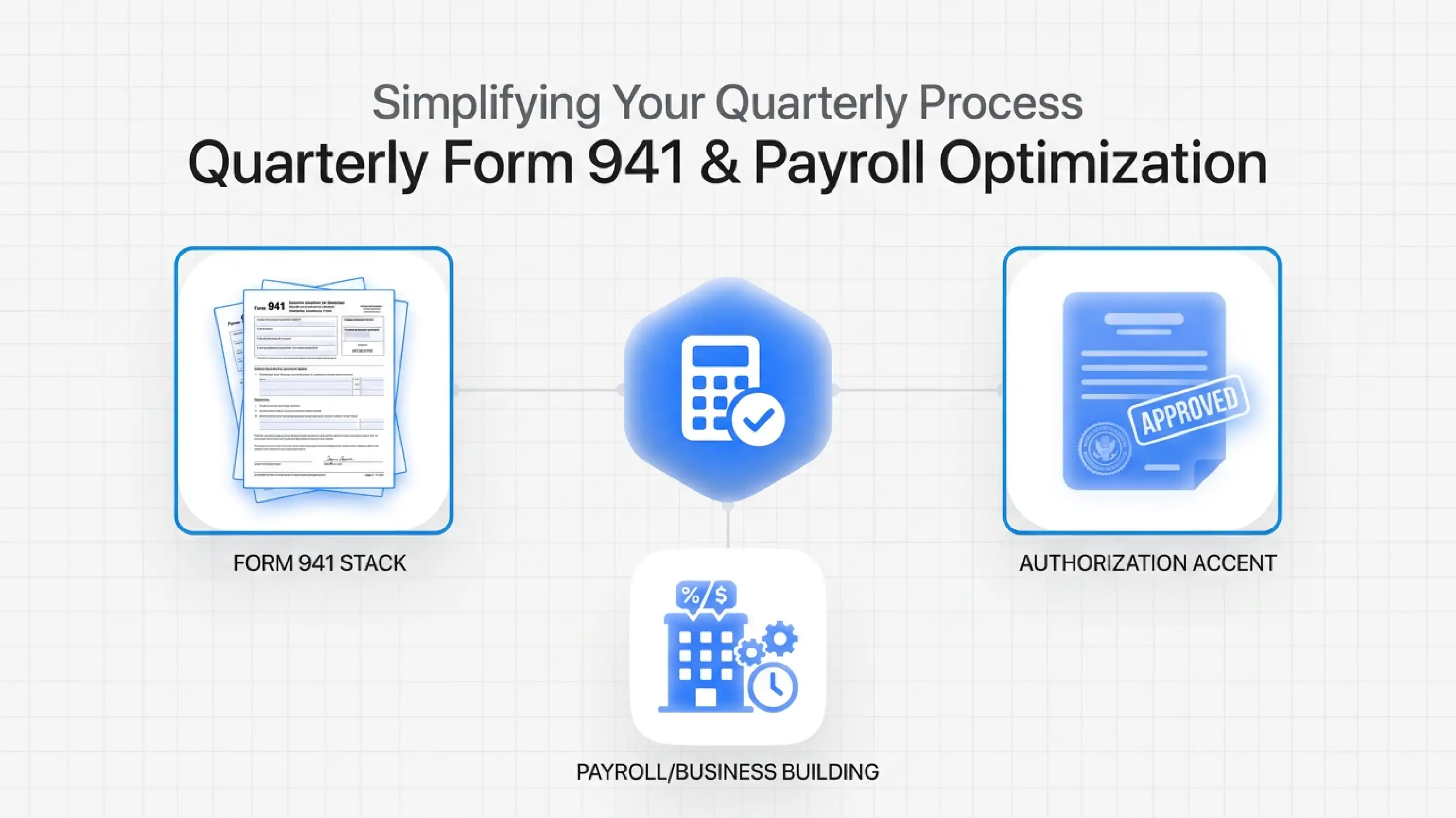
Before a single IRS form gets filed or a single transcript gets pulled, the authorization layer has to be clean.
This sounds basic. But in payroll tax cases involving multiple officers or a change in ownership, incomplete authorization documentation creates IRS access problems mid-case. Pull everything upfront.
The IRS Power of Attorney and Tax Information Authorization guide spells out exactly what each form covers. Know the difference before you file.
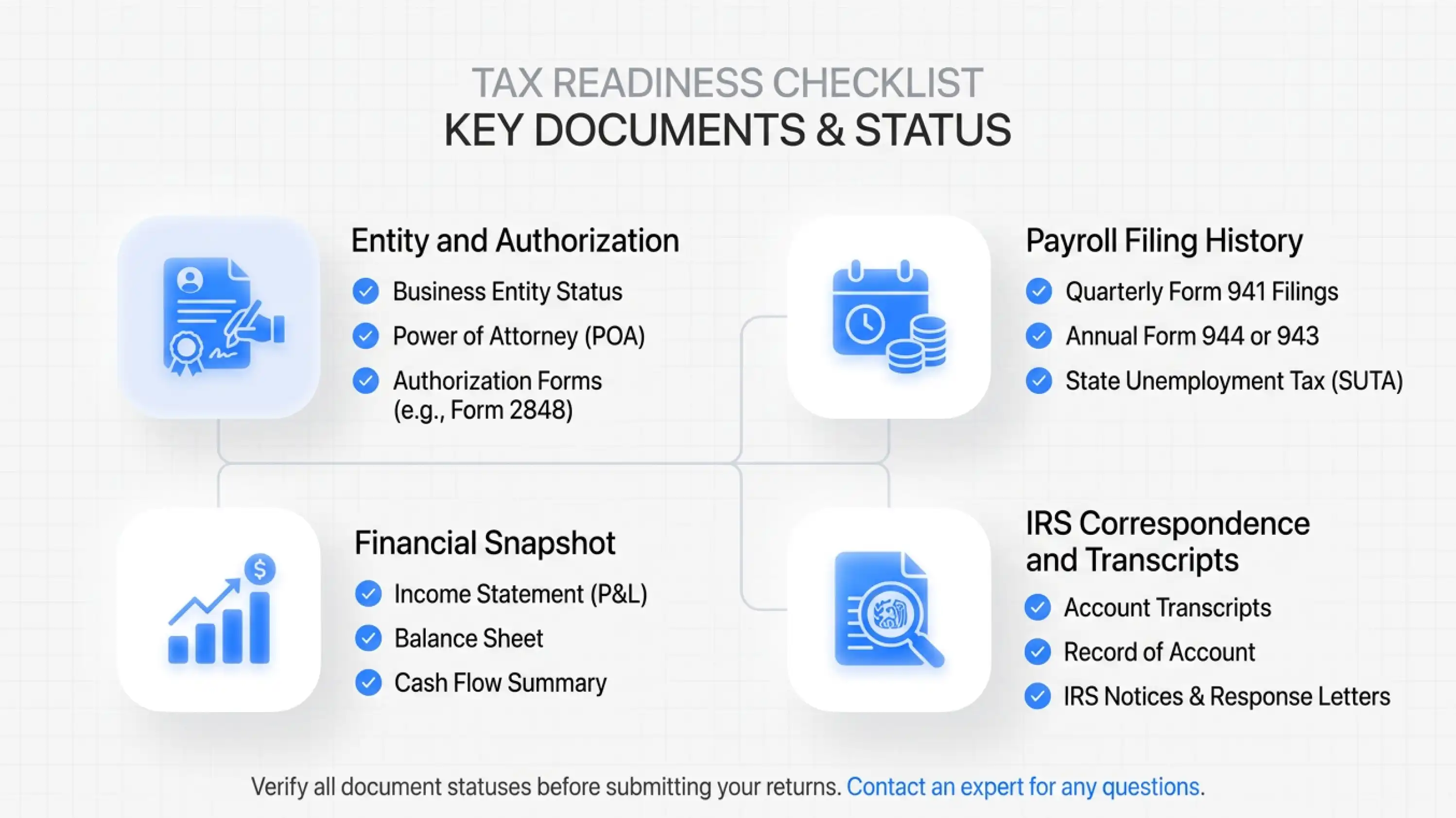
This is the core of the business tax organizer for any payroll tax case.
One detail that regularly derails payroll tax cases: the client's payroll processor records and the IRS transcript do not agree. Get both early. Resolve the discrepancy before you are standing in front of a Revenue Officer being asked to explain a $40,000 gap.
The IRS does not grant payroll tax resolutions in a vacuum. They want to understand what the business can actually pay. Your financial documentation needs to reflect that.
If the firm is still operating and seeking to demonstrate ongoing compliance, documentation of the current deposit history is non-negotiable. The IRS will not consider any resolution option for a business that continues to incur new liabilities.
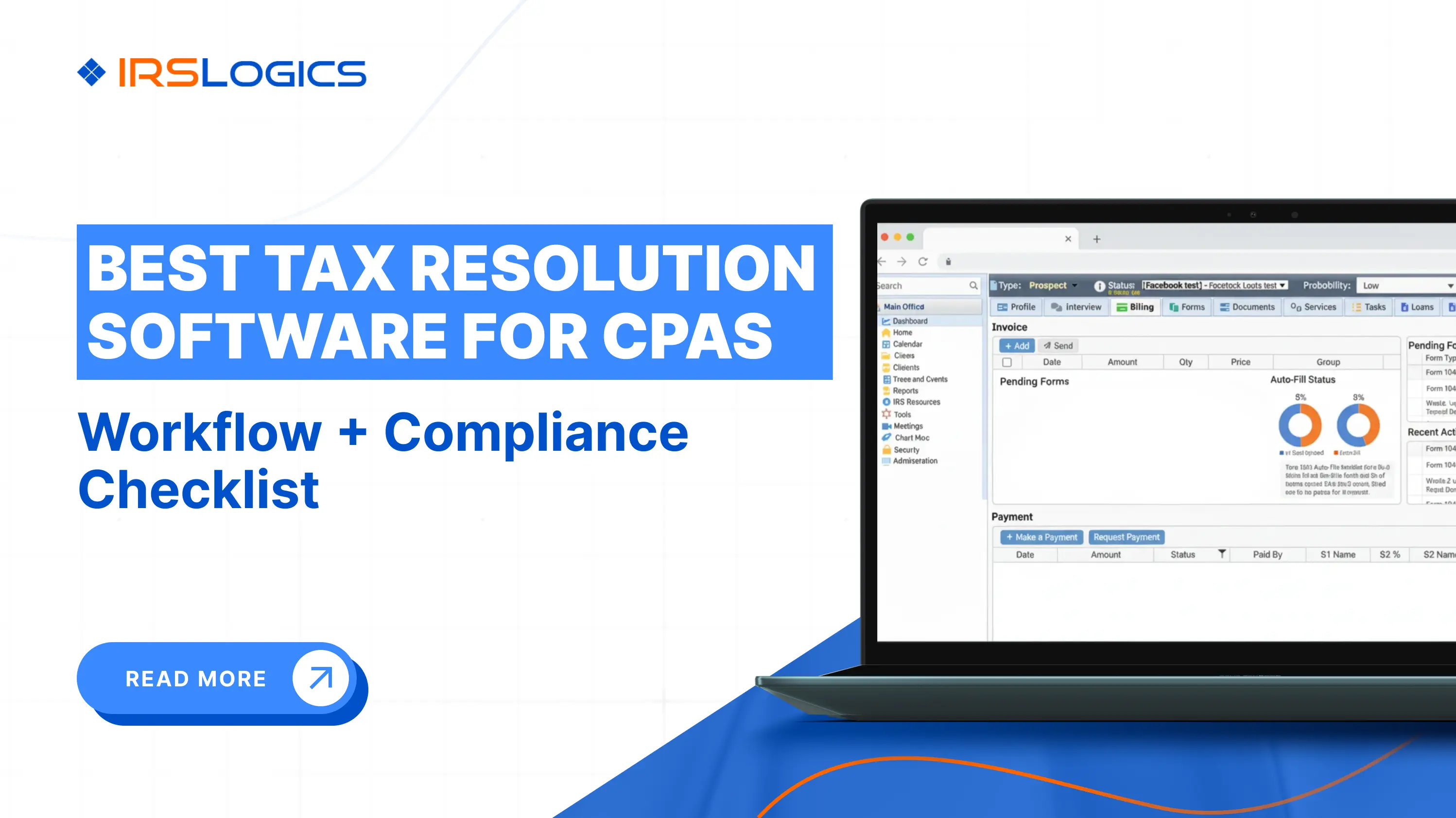
For firms using IRS Logics, the Financial Questionnaire feature handles this entire section digitally. The client fills it in from the client portal, the data maps directly into the 433-B and supporting worksheets, and the case record updates automatically. No re-entry, no version control chaos, no emailed spreadsheets with cells someone accidentally deleted.
The paper trail from the IRS tells you what the IRS already knows. Never go into a resolution case without pulling it.
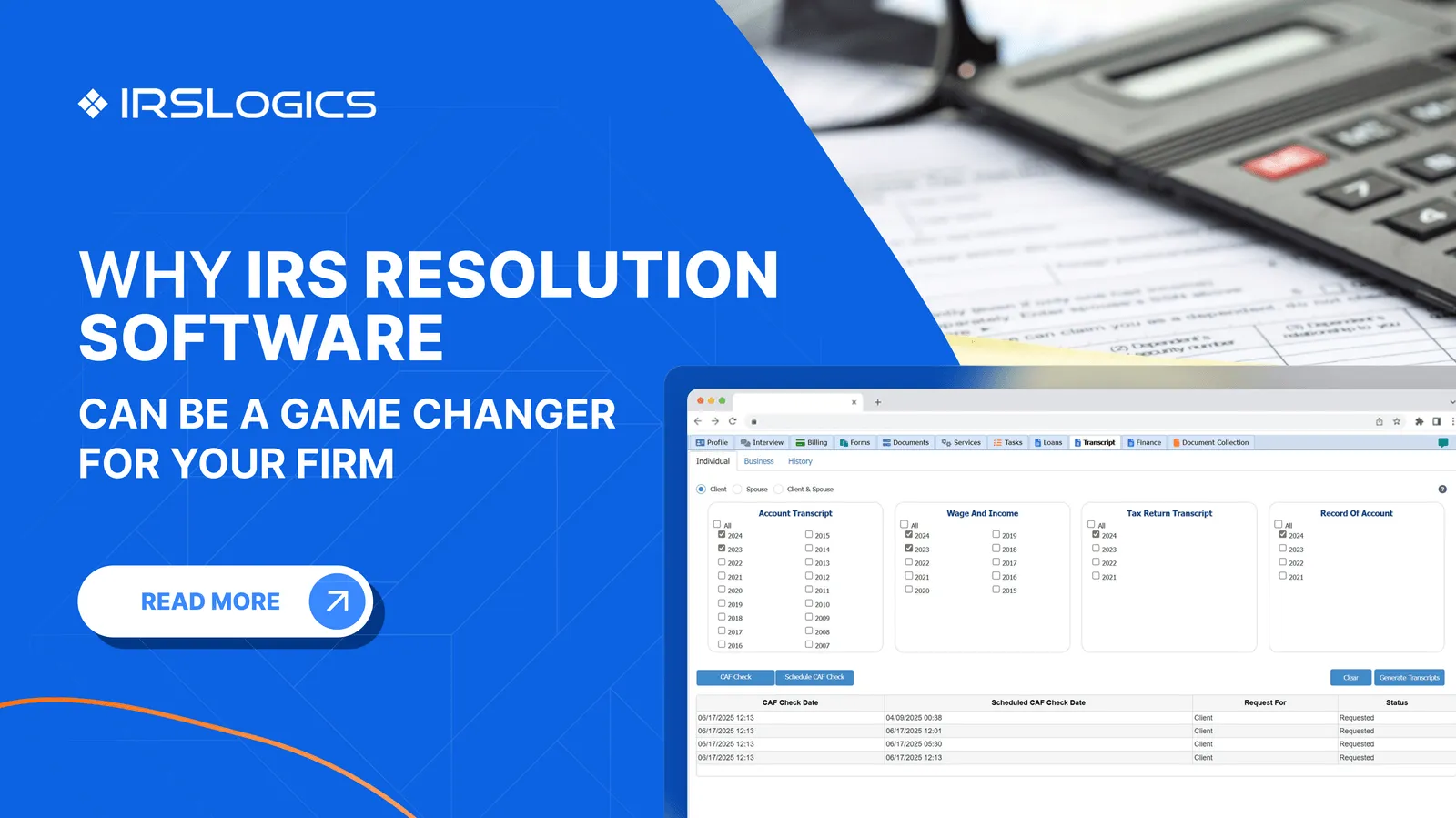
Pulling transcripts manually through the IRS Transcript Delivery System takes time and requires separate logging. For firms managing multiple payroll tax cases simultaneously, that process compounds. The IRS transcript access tools offer one route. Within IRS Logics, transcript requests are initiated directly from the client case record, logged automatically, and attached to the case file as soon as they are returned. No separate spreadsheet. No "did anyone pull this yet" conversation.
Here is what actually happens when a firm skips the structured business tax organizer:
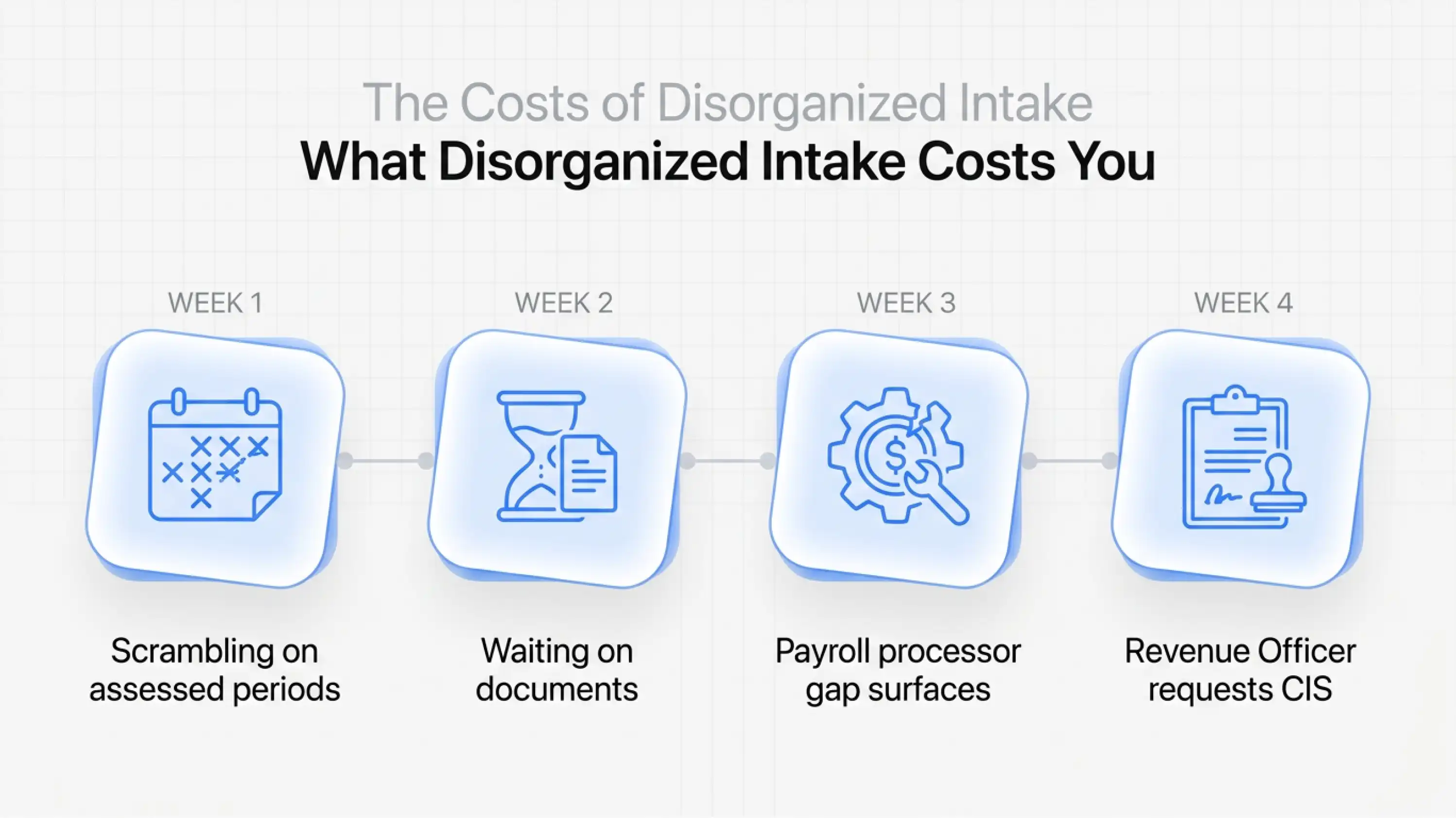
Week one: scrambling to figure out which periods are actually assessed. Week two: waiting on documents the client thought they had. Week three: realizing the payroll processor was switched mid-year, and nobody told you. Week four: the IRS Revenue Officer calls asking for a Collection Information Statement, and your team is still building the case file.
Every one of those delays is a missed opportunity to demonstrate good faith to the IRS. Revenue Officers notice which firms come prepared and which ones are still assembling basic facts two months in. It affects how they approach the case.
A complete business tax organizer, collected at intake using a defined process, eliminates that pattern. The case starts ready to move. Resolution conversations happen earlier. Clients feel the difference.
The National Association of Enrolled Agents publishes practice guidance that consistently reinforces this point: the quality of preparation at intake directly correlates with the speed of case resolution. That is not a bureaucratic observation. It is a practical one.
Tax resolution firms that handle payroll tax cases at volume cannot afford intake that runs on email threads and shared drives. The complexity is too high, and the stakes are too real.
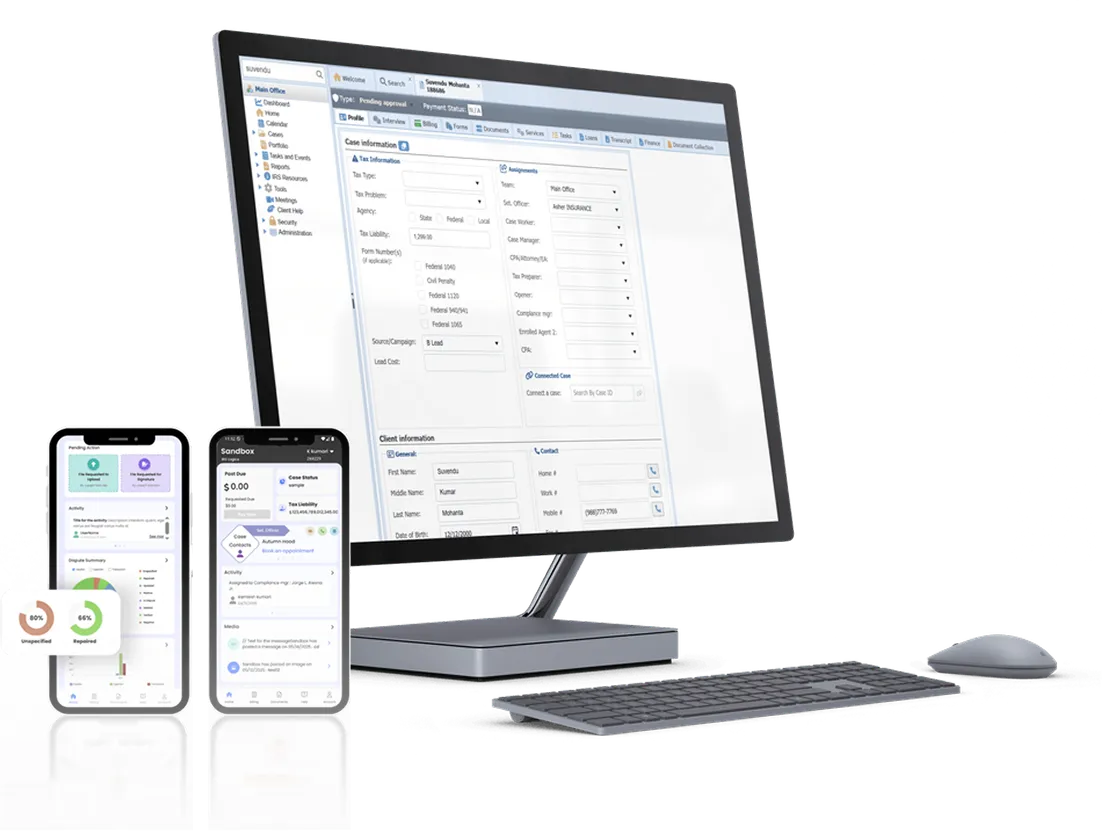
IRS Logics is built specifically for the resolution case lifecycle, from the moment a client comes in to the moment the case closes. For payroll tax cases, that means every item in this checklist has a home inside the platform, and every team member can see what has been collected, what is missing, and what step comes next.
The Document Collection Tab gives firms a structured, trackable document request workflow. Instead of chasing clients via email, the firm sends a document request directly from the case record. The client uploads directly through the Client Portal, the firm gets notified, and the document is attached to the case. No version confusion. No "I sent it last week, didn't you get it?" conversations.
The Financial Questionnaire replaces the back-and-forth financial intake process entirely. The client receives a fillable questionnaire, completes it on their own time, and the data auto-populates the 433-B and related IRS financial forms inside the platform. What used to take two appointments and a round of corrections takes one step.
And because IRS Logics pulls transcripts directly from the case record via its built-in transcript tools, the IRS correspondence and transcript section of this checklist does not require a separate workflow or log. It happens inside the same system where the rest of the case lives.
For firms that are serious about running payroll tax resolution cases cleanly, this is not a nice-to-have. It is the operating infrastructure that makes that standard achievable. Book a demo to see the full workflow in action.
A business tax organizer collects the financial, payroll, and IRS documents needed to evaluate a case. In IRS resolution work, a complete organizer helps firms move faster and build stronger resolution strategies.
Key documents include Forms 941 and 940, payroll tax deposit records, EFTPS history, state payroll tax returns, and IRS account transcripts for all relevant periods.
Yes. Forms 2848 or 8821 should cover each responsible party. In Trust Fund cases, individual authorizations are often required to access records and communicate with the IRS.
Start with the client's available records, then compare them with IRS account transcripts. Any gaps or discrepancies should be identified and resolved before moving forward.
Yes. Digital platforms allow clients to securely upload documents, complete financial questionnaires online, and minimize manual data entry throughout the case.
Missing information usually creates delays later in the case. In payroll tax matters, those delays can limit resolution options and complicate IRS negotiations.
Yes. Operating businesses need current compliance records, bank statements, and receivables reports. Closed businesses typically require dissolution paperwork and final payroll reconciliations.
A business tax organizer is not a compliance checkbox. In payroll tax and IRS resolution cases, it is the foundation on which all subsequent decisions rest. The firms that collect it in full at intake, using a defined process and a tracking system, move faster, make fewer errors, and deliver better outcomes.
The checklist above covers every category that matters. The gap between having a checklist and running a repeatable process is closed by the system behind it.
All
Tax Software
Workflow & Automation
Industry News
Resolution Tips
Tax Resolution Marketing
Lorem ipsum dolor sit amet, consectetur adipiscing elit. Suspendisse varius enim in eros elementum tristique. Duis cursus, mi quis viverra ornare, eros dolor interdum nulla, ut commodo diam libero vitae erat. Aenean faucibus nibh et justo cursus id rutrum lorem imperdiet. Nunc ut sem vitae risus tristique posuere.


Share this article directly by email. Simply enter the recipient’s details below.

Article has been send to you.